Accounting has stopped being just about balancing the books. In 2026 it sits at the centre of compliance, cash flow decisions, client advisory work, and long-term growth planning — and yet accounting firms and businesses across the UK continue running into the same wall: rising costs, a genuine shortage of qualified staff, tighter deadlines, and a regulatory load that keeps growing. ACCA's own employer research puts the scale of the UK's accounting skills shortage at roughly 92% of employers reporting a shortage in relevant roles, and Advancetrack's 2026 Accounting Talent Index found around 74% of firms have had to turn away new client work specifically because of staffing shortages. That's not a cyclical hiring slump. It's a structural gap.
This is where accounting outsourcing has become, for thousands of UK firms and businesses, less of a cost-cutting tactic and more of a core operating decision. This guide covers what accounting outsourcing actually means, every function that can realistically be handed off, what it costs in 2026, how to choose a provider properly, and the regulatory changes currently reshaping why this decision matters more than it did even two years ago.
What Is Accounting Outsourcing, Exactly?
Accounting outsourcing is the practice of delegating accounting and finance tasks to a specialised external team, rather than recruiting, training, and managing every function in-house. The scope can run from simple day-to-day bookkeeping through to payroll processing, tax preparation, management reporting, accounts payable and receivable, and full end-to-end accounting support for a growing business or an accounting practice's entire client book.
Instead of absorbing the time and cost of hiring, training, and retaining an in-house team — and then doing it again every time someone leaves — a business partners with an offshore accounting firm that already has trained professionals, established processes, and secure systems in place. For a large number of UK and US firms, outsourcing accounting services specifically to India has become the preferred route, for reasons that go well beyond the headline cost savings, which this guide covers in detail below.
Why Accounting Outsourcing Makes Genuine Sense in 2026
The accounting landscape has changed meaningfully even in the past two years. Compliance requirements are stricter, reporting expectations from clients and stakeholders are higher, and turnaround times that used to be acceptable now read as slow. At the same time, hiring experienced accountants locally has become both more expensive and more competitive, with qualified candidates fielding multiple offers and salary expectations climbing faster than most firms' fee structures can comfortably absorb.
Outsourcing addresses several of these pressures directly:
- Reduces operational costs meaningfully without compromising the quality of the work
- Gives access to experienced, trained accountants on demand, without a months-long recruitment cycle
- Allows teams to scale quickly during January Self Assessment, year-end, or other seasonal peaks
- Improves turnaround times and accuracy through dedicated, focused capacity
- Frees senior staff to focus on advisory work, client relationships, and growth rather than routine processing
Rather than being perpetually overwhelmed by routine, recurring tasks, firms that outsource well redirect that freed-up capacity toward the strategic work that actually differentiates them and grows revenue.
Every Accounting Function You Can Outsource With Confidence
One of the real advantages of outsourcing is flexibility — almost every accounting function can be handled effectively by an experienced offshore team, and most firms don't outsource everything at once. They start with one function, build trust in the process, and expand from there. Here's the full breakdown.
Bookkeeping Outsourcing
Bookkeeping is the foundation everything else depends on. Outsourced bookkeeping typically covers daily transaction recording, bank and credit card reconciliation, expense categorisation, and monthly or year-end closing. Clean, current books aren't a nice-to-have — they're what makes accurate reporting, smooth compliance, and painless audits possible in the first place. Businesses and firms that want consistency throughout the year, not just a scramble before a deadline, typically move this function offshore first, since it's high-volume, well-defined, and the easiest function to hand off cleanly. We cover exactly what this looks like day to day in our guide to bookkeeping outsourcing for UK accountants and bookkeepers.
Payroll Outsourcing
Payroll errors don't just create admin headaches — they damage employee trust and create genuine compliance risk. Outsourced payroll covers accurate salary processing, payslip generation, statutory deductions, pension auto-enrolment handling, and timely HMRC reporting. With payroll legislation changing regularly — including the IR35 and Employment Rights changes covered later in this guide — outsourcing this function removes the pressure of staying current on every regulatory shift while still hitting tight monthly deadlines.
Management Accounts and Financial Reporting
Timely, accurate management accounts are what actually drive good decisions, not just compliance box-ticking. Outsourced teams prepare monthly management reports, profit and loss statements, balance sheets, and cash flow analysis — giving business owners and accounting firms real visibility into performance trends, emerging risks, and what to plan for next, rather than a backward-looking snapshot delivered too late to act on.
Accounts Payable and Accounts Receivable
Managing payables and receivables efficiently is one of the most direct levers on cash flow and on vendor and customer relationships. Outsourced AP/AR teams handle invoice processing, payment tracking, customer invoicing, follow-ups on overdue balances, and aging reports — giving a business genuine control over cash position while meaningfully reducing the administrative load on internal staff. If accounts payable specifically is the bottleneck, our accounts payable specialist service and guide to hiring an offshore accounts payable assistant cover this in more depth, and for businesses that need dedicated invoicing and billing capacity specifically, our billing executive hiring service is built for exactly that function.
Tax and Compliance Support
Tax preparation and compliance work demands precision and genuinely current knowledge of a regulatory landscape that doesn't stay still. Outsourced accounting support covers VAT return preparation, corporation tax computations, year-end accounts, and audit assistance — helping firms and businesses stay compliant without the last-minute scramble that comes from discovering a deadline has crept up.
QuickBooks, Xero, and Cloud Accounting Support
Cloud accounting has fundamentally changed how businesses manage their finances, and it's also what makes offshore outsourcing genuinely seamless — the offshore team works directly inside your existing Xero, QuickBooks, or Sage account rather than a separate system you have to reconcile against. Outsourced cloud accounting specialists assist with platform setup, migration between systems, historical data cleanup, and ongoing day-to-day support, keeping the platform optimised and error-free rather than slowly accumulating the kind of mess that makes year-end a nightmare.
Virtual CFO Services
Not every growing business needs, or can justify, a full-time in-house CFO — but plenty need that level of strategic financial thinking at some point. Virtual CFO services bring forecasting, scenario planning, fundraising support, and board-level financial reporting to businesses on a fractional basis, without the six-figure salary commitment a full-time senior hire requires.
Industry-Specific Accounting: Real Estate
Generic bookkeeping knowledge doesn't automatically translate to the specific demands of property accounting — trust accounting, rental income reconciliation, service charge accounting, property management reporting, and the particular compliance requirements that come with holding client money. Our real estate accounting services are built specifically around that sector's needs rather than adapted from a generic template after the fact.
Why India Specifically Owns This Market
India didn't become the default outsourcing destination for accounting work by accident — a few structural advantages explain why it's held that position for over two decades, and why the strongest providers keep getting stronger rather than being displaced by newer markets.
A Genuinely Large, Trained Talent Pool
India produces an exceptionally large number of commerce and accounting graduates every year, with training increasingly built specifically around UK GAAP, FRS 102, IFRS, and the cloud accounting platforms UK firms actually run on — Xero, QuickBooks, and Sage chief among them. For a properly trained offshore accountant, UK-specific compliance work is the everyday job, not a skill bolted on after the fact. Many hold ACCA, CA, or CMA qualifications directly, trained from the start for international client work rather than adapting domestic practice to foreign standards.
Real, Substantial Cost Savings
Outsourcing to India typically cuts operational costs by 50–60% compared to hiring an equivalent role in-house in the UK, once salary, employer National Insurance, pension contributions, recruitment costs, and overhead are all factored in. That gap reflects a genuinely different cost of living and labour market — the same underlying economics that shifted software development and customer support offshore over the past two decades — not a discount on the quality of the work itself.
The Time Zone Advantage
India sits roughly 4.5–5.5 hours ahead of the UK, which in practice creates a genuine overnight working advantage rather than a communication barrier. Bookkeeping and reconciliation work handed over at the end of a UK working day is often complete and waiting by the time the UK team logs back on the next morning. Many offshore teams also deliberately shift their working hours to create real daytime overlap with UK business hours, so routine async work and live collaboration both happen within the same relationship.
What UK Accounting Outsourcing to India Actually Costs in 2026
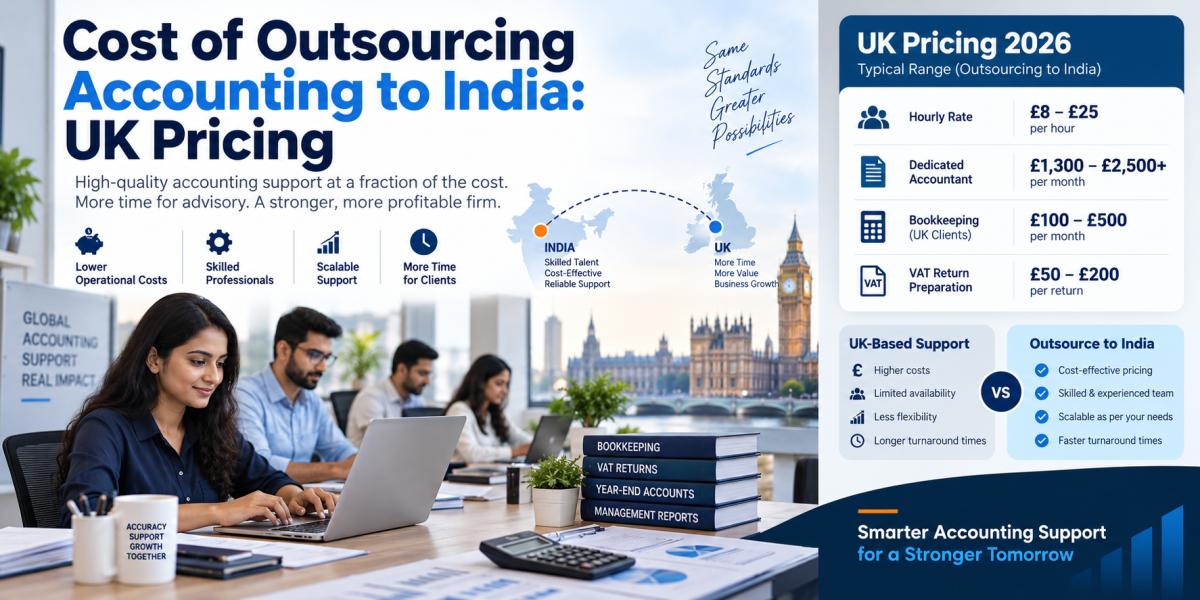
Real numbers matter more than vague promises of "big savings." Here's a grounded comparison across the main hiring models UK businesses and firms actually weigh against each other.
| Hiring Model | Typical Monthly Cost | What's Included |
|---|---|---|
| In-house bookkeeper (UK employee) | £2,000 – £2,900+ (salary £24k–£35k/yr plus 20–30% overhead) | Salary, employer NI, pension, equipment, software, recruitment cost |
| UK freelance bookkeeper | £80 – £1,000+ depending on volume (£20–£50/hr or retainer) | Hourly or retainer-based, scope varies significantly by provider |
| Dedicated offshore bookkeeper | £700 – £950 | Full-time, dedicated, working inside your own software, senior-reviewed |
| Dedicated offshore accountant (senior) | £1,100 – £1,800 | Management accounts, VAT, corporation tax support, review-level work |
A few factors move the real cost within any of these models: transaction volume, the number of bank accounts and entities involved, VAT and payroll complexity, the condition of the existing books, and how frequently reporting is required. A quote that comes in dramatically below the ranges above is worth treating with real caution rather than excitement — it usually signals no review layer, undertrained staff, or an account manager stretched across far too many clients to properly service any of them.
What Changed in 2026: Why the Timing Makes This More Relevant Than Ever
Several UK regulatory shifts landing in 2026 specifically are making extra capacity more valuable right now, not just theoretically useful at some point.
Making Tax Digital for Income Tax
MTD for Income Tax is now mandatory from April 2026 for sole traders and landlords earning above £50,000, with the threshold dropping to £30,000 the following year — bringing an estimated 780,000 taxpayers into quarterly digital reporting for the first time. That's not a one-off compliance project; it's a permanent, recurring increase in bookkeeping and reporting volume for any practice serving clients above those thresholds, landing at exactly the moment hiring has gotten harder, not easier.
Companies House Reform
Director and person-with-significant-control identity verification has been mandatory since November 2025, with the transition window for existing directors continuing to close through 2026. Separately, presenter identity verification and mandatory ACSP registration for filing agents has been delayed to no earlier than November 2027, and the move to software-only accounts filing has been pushed to April 2028 — later than many firms originally planned around. Tracking which of these obligations is actually live, for which clients, is exactly the kind of ongoing administrative work that benefits from dedicated capacity rather than being squeezed into existing workloads.
IR35 and Off-Payroll Working Threshold Changes
From 6 April 2026, the small company thresholds that determine IR35 exemption are rising substantially — annual turnover from £10.2 million to £15 million, and balance sheet total from £5.1 million to £7.5 million — reclassifying an estimated 14,000 UK businesses from medium to small. For businesses newly exempt, the administrative burden of Status Determination Statements disappears; for the contractors they engage, the responsibility for self-assessing IR35 status shifts back to the contractor's own company. Either direction, it's a genuine change in payroll and compliance workload that firms need to track accurately through the transition.
How to Choose the Best Accounting Outsourcing Company in India
Not every provider delivers on the promise of outsourcing, and the gap between a genuinely good partner and a risky one shows up fast once real client work is on the line. Run every shortlisted provider through this checklist before committing to anything.
Essential Criteria to Verify
- UK compliance expertise: genuine, demonstrated experience in UK GAAP, FRS 102, VAT, corporation tax, payroll, and Companies House filing — not generic international accounting knowledge adapted after the fact
- Data security and certifications: ISO 27001, SOC 2, and a UK GDPR-aligned data processing agreement, with actual certificates to show, not just verbal claims
- Software and technology fit: native, daily experience in Xero, QuickBooks, or Sage — whichever platform you actually run on, not a willingness to "learn it"
- Quality control: a defined, multi-level review process with a senior person checking work before it reaches you, and clear accuracy SLAs
- Service flexibility: the option to start with a pilot or trial rather than a long-term contract signed on faith
- Track record and client fit: years actually operating in the UK market, and a client base that resembles your own size and complexity — a provider built for FTSE-scale finance functions is often a poor fit for a ten-person practice, and the reverse is just as true
Red Flags Worth Walking Away From
- A quote significantly below the market rate for trained, reviewed staff
- Vague or evasive answers about who specifically reviews work before it reaches you
- "Years of experience" that doesn't hold up under a direct, specific follow-up question
- No clear, low-friction process for replacing a mismatched hire
- Reluctance to confirm exactly where your data is stored and who has access to it
- No named, accountable point of contact — just a general inbox or ticketing system
For a direct, detailed comparison of named providers against this exact criteria — including where larger enterprise-scale BPOs outperform specialist providers and vice versa — see our full rankings in Top UK Accounting Outsourcing Companies in India and How to Choose the Best Accounting Outsourcing Company for Your UK Practice.
Common Concerns About Accounting Outsourcing — Addressed Directly
Some businesses hesitate to outsource over concerns around data security, quality, or communication breakdown. These are legitimate questions, not reasons to avoid outsourcing altogether — properly run outsourcing firms are built specifically to answer them.
Is Our Data Actually Safe?
Reputable providers operate under strict, individually signed confidentiality agreements (not just a blanket company policy), secure cloud-based systems, role-based access controls rather than shared logins, and regular independent audits against recognised standards. Our dedicated page on data security in outsourced accounting relationships covers exactly what to verify before signing anything — ask for the actual certificates, not just a verbal assurance.
Will Quality Actually Hold Up?
With a dedicated team assigned specifically to your account, a defined multi-level review process, and documented standard procedures rather than ad-hoc handling, quality is generally comparable to — and in many cases better than — a stretched in-house team working under constant time pressure. The structure of the engagement, not the fact that it happens offshore, is what actually determines quality.
Will Communication Genuinely Work?
A properly run offshore relationship should feel like an extension of your own firm, with a named, accountable point of contact, regular reporting, and a clear escalation process for anything urgent — not a disconnected vendor you occasionally check in with and otherwise lose visibility into.
A Practical Onboarding Sequence
Firms that get outsourcing right tend to follow a similar, deliberate sequence rather than transferring everything at once:
- Initial discovery call to align on scope, transaction volume, software, and deadlines
- Pilot engagement with a small, lower-risk batch of client work
- Review of pilot output and refinement of workflows before scaling further
- Gradual transition of additional client files or functions
- Full integration, with regular review meetings built into the relationship from the start, not added later as an afterthought
Starting with a pilot isn't excess caution — it's the fastest way for both sides to surface genuine gaps in process or expectations before they touch a real client deadline.
Who Should Actually Consider Accounting Outsourcing
Accounting outsourcing tends to make the most sense for:
- UK and US accounting firms struggling to hire or retain qualified staff at the pace client demand requires
- CPA firms and tax practices facing seasonal capacity crunches they can't justify permanent headcount for
- Startups and growing businesses that have outgrown DIY bookkeeping but aren't ready for a full in-house finance team
- SMEs looking to control operating costs without sacrificing the quality of their financial reporting
- Firms specifically seeking scalable offshore support that can flex up during January, year-end, or client-onboarding surges
Whether the need is short-term additional capacity or a genuine long-term offshore partnership, outsourcing offers real flexibility without forcing a compromise between cost and quality — provided the provider and the engagement structure are right for the specific situation.
Building Your Own Dedicated Offshore Team
Beyond project-based or task-level outsourcing, many UK firms and businesses choose to build a dedicated offshore team — hiring specific roles that function as an extension of their own staff, just without the local recruitment cycle and salary overhead. This includes:
- Hire an Accountant — general accounting and bookkeeping support
- Hire a Bookkeeper — day-to-day transaction processing and reconciliation
- Hire a Tax Advisor — preparation support for Self Assessment and corporation tax
- Hire a Payroll Specialist — multi-jurisdiction payroll and compliance
- Hire a Financial Analyst — forecasting, reporting, and management accounts
- Hire an Auditor — working papers and audit file preparation
- Hire a QuickBooks Expert — platform-specific setup, cleanup, and support
- Hire a Management Accountant — internal reporting and cost analysis
- Hire a Forensic Accountant — investigative and dispute-related accounting work
- Accounts Payable Specialist and Billing Executive — dedicated invoicing, payment processing, and billing capacity
Why Firms Choose Exuberant Global Specifically
At Exuberant Global, accounting outsourcing is built around reliability, transparency, and genuine long-term partnership rather than a transactional handoff of work. Our teams work closely with accounting firms and businesses to understand existing processes, standards, and expectations before any work begins, rather than fitting every client into the same generic template.
We provide dedicated accounting professionals, secure workflows, regular reporting, and engagement models that scale as your needs change — whether that's support with bookkeeping, payroll, management accounts, accounts payable, or full outsourced accounting across your entire client book. Explore our full range of outsourcing to India services, or go straight to our outsourced accounting services page to see exactly how the engagement works.
Frequently Asked Questions
What's the difference between outsourcing and offshoring? Outsourcing means handing work to a third-party provider; offshoring specifically means that provider is based in another country. UK accounting outsourcing to India is technically both, which is exactly where much of the cost saving comes from.
Is outsourcing suitable for a small practice, or only larger firms? It works well at both ends. A solo practitioner can start with a single part-time offshore bookkeeper covering a few hours a month, while larger firms can build an entire dedicated offshore division covering multiple service lines across their whole client book.
How do these providers actually stay compliant with UK tax rules? Reputable providers employ UK-trained or chartered accountants, run ongoing training on legislative changes, and use UK-specific review checklists — this is worth confirming directly with any provider rather than assuming it's a given.
Will our clients know the work is being done overseas? That depends entirely on how your firm structures client relationships and what your own engagement letters say. Many practices outsource routine processing work without disclosing the specific arrangement, since the deliverable, review, and sign-off all still happen through the firm itself.
Can we outsource just one function, like payroll or VAT, rather than everything? Yes — most providers offer modular services, so you can start with a single function and expand into others once you trust the process and can see the quality for yourself.
How long does onboarding typically take? Usually two to six weeks, depending on complexity and how much data needs migrating. Providers that already work natively in your existing software onboard noticeably faster than those requiring a platform switch.
Do we lose control over our finance function by outsourcing? No — you still approve payments, sign off on accounts, and set the rules. The outsourced team handles the processing and admin work underneath that, not the final decisions.
What happens if there's an error in the work? A proper multi-level review process catches most errors before they ever reach you. Reputable providers also carry professional indemnity insurance and have a clear, fast correction process — worth asking about directly during evaluation, before you need it.
Is there a minimum turnover or company size needed to use these services? No — specialist providers built for SMEs and practices, including sole traders and startups, typically have no minimum requirement, unlike larger enterprise-scale BPOs that are genuinely built for bigger, more complex operations.
Can outsourced accountants deal directly with HMRC or Companies House on our behalf? Yes, provided formal authorisation is granted, such as HMRC agent authorisation — confirm this is explicitly covered in your service agreement rather than assumed.
The Bottom Line
Accounting outsourcing in 2026 isn't primarily a cost-cutting decision anymore — for a growing number of UK firms and businesses, it's become one of the more reliable ways to address a genuine, well-documented talent shortage while keeping pace with a compliance burden that keeps expanding. Firms building this into their operating model now are positioning themselves to keep growing through a period that's genuinely difficult for the profession as a whole.
The right starting point isn't the cheapest provider on a list — it's the one whose typical client looks like you, whose review process you can actually verify, and who's willing to prove it with a pilot before you commit to anything long-term. If you're ready to see what that looks like in practice, Exuberant Global works as a genuine extension of UK accounting firms and businesses — dedicated professionals, transparent pricing, and a process built to prove itself before you commit.
Ready to Scale Your Business?
Connect with our experts to learn how our outsourcing solutions can drive growth.
Book a Discovery Call