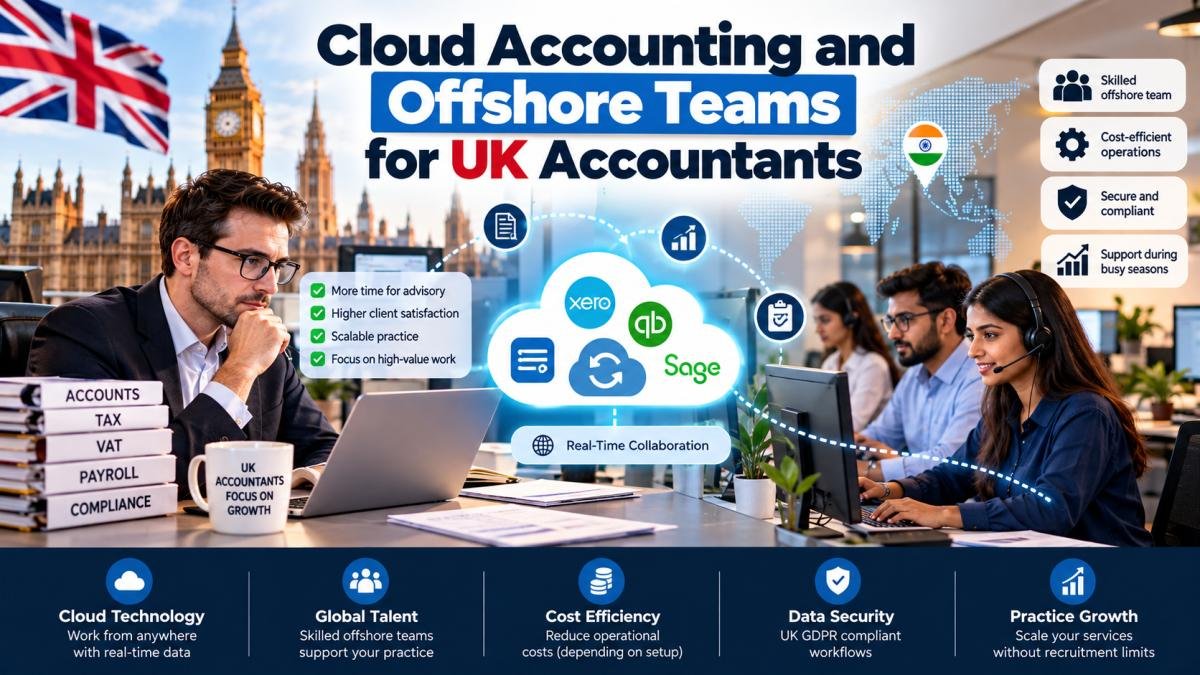
Cloud Accounting and Offshore Teams for UK Accountants
Cloud accounting and offshore teams are changing how UK accounting firms manage client work, organise their staff and plan for growth. By combining cloud-based accounting software with a well-managed offshore team, practices can create more flexible workflows, reduce repetitive manual work and manage growing workloads without relying exclusively on local recruitment.
For many UK accountants, the challenge is familiar. Client expectations are increasing, reporting deadlines continue to arrive, and experienced staff need to divide their time between bookkeeping, accounts preparation, compliance work and client advice. Recruiting additional employees is one option, but it is not the only way to increase a practice's capacity.
Cloud accounting provides a shared digital environment for financial records and workflows. Offshore accounting support can add people to suitable parts of those workflows. When the two are implemented together, the result can be a more organised operating model in which routine work is prepared efficiently and UK-based professionals retain appropriate control over technical decisions, reviews and client relationships.
However, success depends on more than buying software or handing tasks to an external provider. Accounting firms need clear processes, secure access, suitable contracts, reliable communication and a consistent quality-control framework.
This guide explains how cloud accounting and offshore teams work together, which tasks can be delegated, how to choose the right technology and provider, what UK practices should consider about data protection and compliance, and how to calculate whether the arrangement makes commercial sense.
Cloud accounting and offshore accounting support are two different approaches that can complement one another. Understanding their individual roles helps firms decide how to combine them effectively.
What Is Cloud Accounting?
Cloud accounting uses software hosted online to record transactions, maintain ledgers, reconcile accounts and produce financial reports. Rather than relying entirely on a programme installed on a single office computer, authorised users can access the system over the internet from approved devices.
Depending on the platform and subscription, features may include bank feeds, invoice management, expense tracking, reconciliation tools, payroll integrations, management reports and connections with other business systems.
Examples include Xero, QuickBooks Online and Sage. The most suitable platform depends on the practice's client base, service requirements, existing systems and budget.
What Is an Offshore Accounting Team?
An offshore accounting team is based in another country and supports accounting activities for a UK practice or business. The arrangement may involve a dedicated team, a shared service team or an external provider responsible for a defined set of tasks.
Depending on the provider's capabilities, outsourced work may include transaction processing, bookkeeping, bank reconciliations, preparation of working papers, accounts production support and management reporting.
Offshore team members can work within the cloud platforms and documented procedures approved by the UK firm. This enables the practice to allocate work according to complexity and keep review and approval responsibilities clearly defined.
| Cloud accounting | Offshore accounting support | Combined benefit |
|---|---|---|
| Provides a shared digital environment | Adds capacity to complete agreed work | Work can be allocated and tracked more consistently. |
| Stores and processes financial information | Prepares records, schedules and reconciliations | UK reviewers can focus on exceptions and review. |
| Supports reporting and integrations | Helps prepare recurring reporting outputs | More predictable delivery workflows |
| Provides permissions and activity records where supported | Works through authorised access | Clearer access management and accountability |
The important distinction
Cloud accounting is the technology layer. Offshore accounting is a delivery model. Software alone does not guarantee better productivity, and offshore staffing alone does not guarantee lower costs. The value comes from combining the right systems, people, processes and controls.
Why Cloud Accounting and Offshore Teams Work Well Together
The combined model can help practices address two connected operational challenges: how work is organised and who has the capacity to complete it. Cloud software makes information easier to share through controlled access, while an offshore team can provide additional resources for suitable activities.
Shared Access to Current Records
Authorised users can work with the same accounting records rather than passing multiple versions of spreadsheets and files between teams. This can reduce duplication and make it easier to identify outstanding work.
More Flexible Work Allocation
Practices can assign suitable tasks to employees with available capacity, regardless of location, while retaining clear ownership of each client engagement.
Better Use of Qualified Staff
Routine preparation work can be delegated where appropriate, giving experienced UK staff more time for technical review, client discussions and work requiring professional judgement.
More Consistent Workflows
Standard templates, task lists and digital document storage can help teams follow the same procedures across recurring bookkeeping and accounts assignments.
Capacity During Busy Periods
A practice may use an agreed offshore resource to help handle seasonal increases in workload, subject to available capacity, onboarding and suitable review arrangements.
Potential Cost Efficiencies
Depending on the arrangement, firms may reduce the cost of delivering selected services. Savings should be calculated after including provider fees, software, management time, training and quality review.
Real-Time Collaboration Does Not Mean No Oversight
Cloud software makes collaboration easier, but it does not eliminate the need for a structured review process. Teams still need to agree which tasks can be completed independently, which transactions require approval and which issues must be escalated to the UK practice.
For example, an offshore bookkeeper might prepare a bank reconciliation and flag unexplained differences. The designated reviewer can then investigate unusual transactions, confirm the accounting treatment and approve the completed work according to the firm's procedures.
This division of responsibilities is more effective than expecting every team member to perform every task or giving an external provider unrestricted access to financial systems.
Choosing the Right Cloud Accounting Software for a UK Practice
The best cloud accounting platform is not necessarily the one with the largest number of features. It is the one that supports the practice's client requirements, fits its existing workflows and can be used securely by authorised employees and external providers.
| Platform | Areas to assess | Questions for your practice |
|---|---|---|
| Xero | Bank feeds, reconciliation workflows, reporting and integrations | Does it fit the needs of your client portfolio and existing processes? |
| QuickBooks Online | Bookkeeping, invoicing, bank transactions and reporting | Are the required features and access arrangements suitable for each client? |
| Sage cloud products | Accounting, reporting and integration requirements | Does the chosen product support the firm's accounting and compliance workflow? |
| Practice management software | Task assignment, deadlines, client communication and workflow tracking | Can staff see task ownership, progress, outstanding queries and review status? |
This is a starting point for evaluating software, not a product ranking. Features, integrations and subscription terms vary by product and plan. Confirm the current functionality with each vendor.
Features Worth Evaluating
- Role-based permissions: Can access be restricted according to each user's responsibilities?
- Audit history: Does the platform provide useful records of relevant activity and changes?
- Bank-feed reconciliation: Can suitable transactions be matched efficiently, with exceptions identified for review?
- Document management: Can supporting invoices, statements and schedules be stored and retrieved consistently?
- Reporting: Can the practice produce the reports required by its clients?
- Integration: Does the platform connect with payroll, practice management or document tools already in use?
- Data export and continuity: Can the firm retrieve its records and maintain continuity if it changes providers?
- Support and training: Can the team obtain assistance when software or workflow issues arise?
Do Not Ignore the Cost of Software Access
When adding an offshore team, check whether your software subscriptions allow the intended access arrangements and whether additional licences or permissions are required. Avoid sharing a single user account between several people to save money. Individual accounts and appropriate access controls make it easier to manage security and accountability.
Which Accounting Tasks Can UK Firms Outsource to Offshore Teams?
A useful starting point is to separate tasks that follow documented procedures from activities that require extensive professional judgement, sensitive client discussions or formal approval. Some work can be delegated almost entirely at the preparation stage, while other work needs regular input from a UK-based accountant.
| Accounting task | Possible offshore contribution | UK practice responsibility |
|---|---|---|
| Bookkeeping | Transaction coding, ledger updates and record maintenance | Resolve unusual items and review completeness. |
| Bank reconciliations | Match transactions, investigate routine differences and prepare reconciliations. | Review unresolved discrepancies and approve the result |
| Accounts payable | Process supplier invoices and maintain supplier records | Retain appropriate payment approvals and fraud controls |
| Accounts receivable | Allocate receipts, update ledgers and prepare aged debt reports | Manage significant disputes, credit decisions and sensitive communications |
| Year-end accounts support | Prepare schedules, working papers and draft accounts | Review accounting treatment, disclosures and final deliverables |
| Management accounts | Prepare reporting packs and supporting schedules | Interpret performance and advise clients |
| Payroll support | Process agreed payroll inputs and prepare draft outputs | Maintain approval, access and compliance controls |
| VAT preparation | Organise transactions and prepare draft return information | Check exceptions, review the return and manage submission responsibilities |
Tasks That Usually Need Greater UK-Side Involvement
Complex tax advice, difficult client disputes, unusual accounting treatments, final sign-off and work requiring specific professional authorisation often need more direct involvement from an appropriately qualified or authorised professional.
This does not mean that an offshore team cannot contribute to complex assignments. It means that responsibilities, competence requirements, review arrangements and the boundaries of delegated work must be agreed before the work begins.
A practical rule for allocating work
Delegate preparation where it is appropriate, document the expected output, identify who reviews it and establish a clear escalation route for anything outside the agreed process. The final allocation should reflect the task, the provider's competence and the practice's professional obligations.
How Cloud Accounting and Offshore Teams Work Together
A successful arrangement begins with a clear workflow. Each task needs an owner, a defined input, a required output, a deadline and a review step. Cloud tools can help teams manage this process without relying on long email chains or separate versions of the same spreadsheet.
Invoices, receipts, statements and other records are collected through approved channels.
Authorised team members record transactions and prepare reconciliations or schedules.
Exceptions are investigated and the completed work is checked by the designated reviewer.
The UK practice completes the required approvals and delivers the agreed output to the client.
Example: Monthly Bookkeeping for a UK Client
Imagine an accountancy practice managing the monthly bookkeeping of a group of small UK businesses. Each client submits invoices and receipts, and the practice needs reconciled records before preparing management reports.
- Collect: The practice gathers the required records and confirms that the period's documents are complete.
- Allocate: The offshore team receives the agreed tasks through a controlled workflow.
- Process: The team records transactions, matches suitable bank-feed entries and prepares reconciliations.
- Flag: Missing documents, unusual transactions and unresolved differences are placed in an exception list.
- Review: The UK accountant reviews the completed work and decides how to resolve outstanding matters.
- Report: Once approved, the required reporting outputs are prepared and delivered according to the agreed timetable.
This process is more reliable when the practice has standard coding rules, clear document requirements and written instructions for common exceptions. If each client is processed differently without documentation, the offshore team may need frequent clarification and the expected efficiency gains can disappear.
How to Manage Time-Zone Differences
Working across the UK and India can provide useful scheduling flexibility, but it does not automatically create a round-the-clock operation. The actual overlap depends on the season, agreed working hours and staff availability.
Practices should set an agreed period for live communication, identify a primary contact on each side and use written handovers for outstanding issues. Tasks that require an immediate answer should not be assigned without a realistic escalation route.
- Agree the working hours and expected response times.
- Use a shared task tracker with clear deadlines and ownership.
- Document unresolved questions rather than relying on informal messages.
- Schedule regular review meetings for recurring problems and process changes.
Cloud Accounting Security, Confidentiality and UK GDPR
Financial records can contain personal information, payroll details, bank information and commercially sensitive documents. Allowing an offshore team to access these records therefore requires careful planning. Cloud software does not make data secure automatically, and using a reputable provider does not remove the firm's responsibility to assess the arrangement.
Understand International Data Transfers
Under UK GDPR, sending personal information to a separate organisation outside the UK, or making that information accessible to it, can constitute a restricted transfer where the relevant legal conditions apply.
The Information Commissioner's Office (ICO) explains that organisations must assess whether transfer rules apply and ensure the transfer is covered by UK adequacy regulations, appropriate safeguards or a valid exception. Depending on the arrangement, appropriate safeguards may include the UK International Data Transfer Agreement (IDTA) or the UK Addendum to the EU Standard Contractual Clauses, together with the required transfer risk assessment.
See the ICO's guide to international transfers and its guidance on other UK GDPR obligations.
Security Measures Every Practice Should Assess
- Individual user accounts: Give each authorised person their own login and remove access promptly when their role ends.
- Multi-factor authentication: Use additional authentication protection wherever available and appropriate.
- Least-privilege access: Grant only the permissions needed to complete assigned tasks.
- Approved devices: Define how devices are managed, updated and protected.
- Secure document exchange: Use approved systems rather than unprotected email attachments or personal file-sharing accounts.
- Activity monitoring: Review available access logs and investigate suspicious or unexpected activity.
- Written contracts: Define confidentiality, security, processing instructions, incident reporting and any permitted subcontracting.
- Continuity planning: Understand backup, recovery and incident-response arrangements.
What Should the Outsourcing Contract Cover?
The agreement should clearly define the services, data involved, permitted purposes, access arrangements, responsibilities of each party, security expectations, retention and deletion procedures, incident notification and support for compliance obligations.
The firm should also establish whether the provider uses subcontractors and how any further processing or international transfers will be authorised and protected. The precise requirements depend on the contractual structure and the data being processed.
Important distinction
A UK-hosted cloud platform does not, by itself, resolve the rules for giving an offshore service provider access to personal information. The practice should assess the actual data flows, the parties involved and the relevant UK GDPR requirements before access is granted.
Making Tax Digital, VAT and Compliance Considerations
UK accounting firms using cloud platforms and offshore support must ensure that their workflows remain consistent with the applicable tax rules and their clients' obligations. Software can support record-keeping and reporting, but the practice still needs appropriate procedures for checking the information and meeting deadlines.
Making Tax Digital for VAT
Making Tax Digital for VAT requires affected businesses to maintain relevant digital records and use compatible software to submit VAT returns, subject to the applicable rules and exemptions. Firms should verify that the chosen software and workflow meet HMRC requirements.
For official guidance, see HMRC's guidance on using software to submit VAT returns.
Define Who Prepares, Reviews and Submits
An offshore team may prepare bookkeeping records or draft VAT return information, depending on the agreement. The practice should explicitly define who checks the figures, resolves exceptions, approves the return and completes the submission.
The same principle applies to payroll, statutory accounts, tax computations and other compliance work. A documented workflow helps the practice maintain visibility over progress and prevents an assumption that another team has completed a task.
Maintain a Compliance Calendar
Use a shared calendar or practice management system to track relevant filing dates, document collection deadlines, review stages and client approvals. Build time into the process for incomplete records and unexpected queries rather than scheduling every task at the last possible moment.
- Assign an owner to each deadline.
- Record when source documents are due from the client.
- Set internal completion and review dates ahead of the final deadline.
- Escalate missing information or unresolved issues promptly.
- Retain evidence of the required review and approval.
How Much Can Cloud Accounting and Offshore Teams Save?
The financial case for outsourcing should be based on the total cost of delivering a service, not simply the difference between a UK salary and an offshore hourly rate. Software licences, recruitment, training, supervision, communication, rework and quality assurance all affect the final result.
Compare the Total Cost of Delivery
| Cost category | In-house model | Cloud and offshore model |
|---|---|---|
| Staffing | Salary, employer costs, recruitment and onboarding | Provider fees or agreed offshore team costs |
| Software | Accounting, document and workflow subscriptions | Existing licences plus any additional required access or tools |
| Management | Work allocation, supervision and performance reviews | Handover, communication, task management and supervision |
| Training | Induction, technical training and ongoing development | Onboarding, process documentation and training on the firm's systems |
| Quality assurance | Internal checks and corrections | Review time, corrections and oversight of outsourced deliverables |
| Security and administration | Access controls, contracts and internal compliance work | Access controls, supplier due diligence and applicable transfer safeguards |
Illustrative Cost Calculation
Consider a hypothetical practice that currently spends £4,000 a month delivering a particular set of recurring accounting tasks. It is evaluating an offshore arrangement to handle an agreed portion of that workload.
Example monthly costs
| Cost item | Illustrative amount |
|---|---|
| Current delivery cost | £4,000 |
| Offshore service fee | £1,800 |
| Additional software and access | £100 |
| UK review and coordination time | £400 |
| Other incremental costs | £100 |
| Total cost after outsourcing | £2,400 |
| Illustrative monthly difference | £1,600 |
In this example, the modelled cost difference is £1,600 a month, or 40% of the original £4,000 cost. These figures are hypothetical and do not represent a guaranteed saving or a quoted Exuberant Global price.
Calculate Your Own Potential Saving
Use the following formula when comparing two delivery models:
Net saving = Current total cost − New total cost
Saving percentage = (Net saving ÷ Current total cost) × 100
Make sure the comparison covers the same volume and standard of work. If the new model requires more UK review time, produces additional corrections or introduces new administrative costs, include those costs before deciding whether the arrangement is worthwhile.
Also consider the value of additional capacity. A practice may benefit even where direct cost savings are modest if the arrangement enables it to meet deadlines, take on suitable new clients or protect senior staff time. Those benefits should be evaluated separately rather than assumed to translate automatically into profit.
How to Choose the Right Offshore Accounting Partner
An effective offshore partner should understand the work being delegated, follow the firm's procedures and communicate clearly when something does not match the expected process. The lowest quotation is not necessarily the best commercial choice if it creates extra review work or unreliable delivery.
Evaluate These Seven Areas
- Relevant experience: Ask about the accounting tasks, software and types of client work the team has handled.
- Staff competence: Confirm the team's qualifications and experience where they are relevant to the services being provided.
- Quality procedures: Understand how work is checked, how errors are corrected and how repeated issues are prevented.
- Communication: Agree working hours, escalation routes, response times and the format of handovers.
- Security: Assess user access, device management, confidentiality, incident response and relevant data transfer safeguards.
- Capacity: Confirm the provider can handle the proposed workload and explain how absences or peak periods will be managed.
- Transparent pricing: Establish what is included, what is charged separately and how changes in scope are handled.
Start with a Defined Pilot
Instead of transferring an entire client portfolio immediately, choose a limited and well-documented process. For example, a firm might begin with bank reconciliations for a small group of clients before expanding into additional bookkeeping or accounts preparation work.
Agree the expected outputs, review criteria, deadlines and communication arrangements in advance. Compare the results with the firm's existing process and identify any problems before expanding the scope.
A pilot is also an opportunity to test whether the software access, document collection process and internal review capacity are sufficient. A provider may perform well, but the overall arrangement can still struggle if the practice's own workflows are unclear.
To explore how offshore support can be structured for UK businesses, see: Outsourced Finance Team in India for UK Businesses.
How to Implement Cloud Accounting and Offshore Support
A phased rollout gives the practice time to document its processes, establish security controls and build confidence in the new workflow. It also makes it easier to identify whether delays are caused by the software, the process, the quality of source information or the allocation of responsibilities.
Phase 1: Review the Current Workflow
List the recurring tasks the practice performs, who currently completes them, how long they take and where delays occur. Identify which tasks are suitable for standardisation and which require more direct professional judgement.
Phase 2: Standardise Procedures
Prepare task instructions, coding guidance, document checklists, exception rules and review criteria. The instructions should explain what a complete output looks like and what the team should do when information is missing.
Phase 3: Confirm Technology and Security
Check the chosen cloud platform, user permissions, authentication, document-sharing arrangements and access logs. Complete the required supplier due diligence, contractual arrangements and data protection assessments before granting access to personal information.
Phase 4: Train the Teams
Train the UK and offshore teams on the agreed workflow, software, naming conventions, deadlines and escalation procedures. Make sure both sides understand who can approve work and who must be consulted when unusual transactions arise.
Phase 5: Run a Pilot and Measure Results
Select a limited group of tasks or clients. Track turnaround time, the number of errors, outstanding queries, review time and total delivery cost. Use the results to refine the process before expanding the arrangement.
Phase 6: Expand Gradually
Add further work only when the initial process is stable and the practice has enough review capacity. Review performance regularly and update documentation whenever software, client requirements or accounting procedures change.
What should you measure?
Monitor on-time completion, unresolved exceptions, error and rework rates, total cost per assignment, time spent on review, outstanding client documents and staff workload. These measures provide a more useful picture than simply counting the number of tasks completed.
Common Mistakes When Combining Cloud Accounting and Offshore Teams
1. Moving Disorganised Processes into New Software
Cloud software will not automatically fix inconsistent coding, missing documents or unclear responsibilities. Map and improve the workflow before transferring it.
2. Choosing a Provider Solely on Price
A low fee may be offset by errors, delays, extra management time or repeated corrections. Assess total delivery cost and quality together.
3. Giving Everyone Too Much Access
Access should reflect each person's responsibilities. Use individual accounts, appropriate permissions and a documented process for changing or removing access.
4. Failing to Document Instructions
Verbal instructions and informal messages are difficult to maintain across a growing team. Written procedures make it easier to train new staff and apply consistent standards.
5. Assuming Automation Removes the Need for Review
Automated matching and data extraction can produce exceptions or incorrect results. Establish checks that are proportionate to the risk and complexity of the work.
6. Treating Offshore Staff as a Separate Operation
If the offshore team does not receive timely answers, updated procedures or useful feedback, the same mistakes may recur. Include the team in the relevant workflow reviews and process updates.
7. Expanding Before the Pilot Is Stable
Adding more clients before resolving the initial problems can magnify errors and delays. Use measurable criteria to decide when a process is ready to scale.
How Exuberant Global Supports UK Accounting Firms
Exuberant Global provides outsourced accounting and bookkeeping support for UK accounting practices looking for additional operational capacity. Depending on the agreed scope, support may cover recurring accounting processes that can be documented, delegated and reviewed within the firm's operating model.
Cloud-based workflows can help connect the practice's internal team with an external delivery team, subject to the systems, permissions, contractual arrangements and security requirements involved. The objective is to make work allocation clearer and help UK-based professionals maintain appropriate oversight of client engagements.
Before starting an arrangement, firms should define the tasks to be delegated, the expected turnaround times, the review process and the relevant confidentiality and data protection measures. The right scope depends on the firm's client base, internal capacity and quality requirements.
If your practice is considering additional support, visit Exuberant Global to explore the available accounting and bookkeeping services.
You can also read our guide to what accounting outsourcing is and how it works for a broader explanation of the outsourcing model.
Looking to Improve Your Accounting Workflow?
Explore how cloud accounting, standardised processes and outsourced support may help your practice manage recurring work and plan capacity more effectively.
Frequently Asked Questions
1. What is cloud accounting for UK accountants?
Cloud accounting uses online software to record financial transactions, reconcile accounts and prepare reports. Authorised users can access the relevant records remotely, subject to permissions and the platform's features.
2. What are offshore accounting teams?
Offshore accounting teams are based outside the UK and carry out agreed accounting activities for a UK practice or business. Their responsibilities may include bookkeeping, reconciliations, working-paper preparation and reporting support.
3. Why combine cloud accounting with offshore teams?
The combination can help firms organise work in a shared digital environment while adding capacity for suitable tasks. It may improve workflow visibility and allow UK accountants to focus more time on review and client-facing responsibilities.
4. Which cloud accounting software is suitable for UK firms?
Xero, QuickBooks Online and Sage cloud products are examples worth evaluating. The right choice depends on the firm's client base, reporting needs, integrations, budget and existing processes. Check current features and subscription requirements before choosing.
5. Can UK accountants outsource bookkeeping to India?
UK accounting practices can engage an offshore provider for suitable bookkeeping and related tasks, subject to the applicable legal, contractual, professional and data protection requirements. The practice should establish clear responsibilities, security safeguards and review procedures.
6. Is outsourcing accounting work to India cost-effective?
It can be, depending on the provider's fees, task complexity, software costs, management time and the amount of UK-side review required. Compare the total cost of delivering equivalent work rather than assuming a particular percentage of savings.
7. Is cloud accounting secure when offshore teams use it?
Security depends on the platform configuration, user permissions, authentication, device controls, contracts and the provider's practices. Firms should assess risks and implement appropriate technical and organisational measures before allowing offshore access.
8. Does UK GDPR apply when accounting data is accessed from India?
UK GDPR transfer rules may apply when a UK organisation sends personal information to, or makes it accessible to, a separate organisation outside the UK. The parties should assess the actual data flows and use an applicable transfer mechanism or valid exception where required.
9. Can offshore teams prepare VAT returns?
An offshore team may prepare VAT information or draft returns if this falls within the agreed scope and the team has the appropriate competence. The practice should define review, approval and submission responsibilities and ensure that the relevant HMRC requirements are met.
10. Will offshore accounting replace UK accountants?
Offshore support is generally best understood as an additional delivery resource rather than a complete replacement for the UK practice. Firms still need appropriate technical judgement, client communication, quality review and accountability for their engagements.
11. How should a firm start working with an offshore team?
Start with a defined set of tasks, document the workflow, confirm data protection arrangements, train both teams and run a limited pilot. Measure turnaround time, error rates, review effort and total cost before expanding the scope.
12. How do time-zone differences affect offshore accounting?
Time-zone differences can offer scheduling flexibility but also create communication gaps. Agree working hours, handover procedures, response times and escalation routes so that urgent questions and unresolved issues are handled appropriately.
Conclusion: Building a More Flexible Accounting Practice
Cloud accounting and offshore teams can work well together when a UK practice has clear processes, suitable technology and a realistic understanding of what can be delegated. Cloud software provides a shared environment for financial records, while an offshore team can add capacity for agreed preparation and processing activities.
The benefits are not automatic. Firms need to consider the full cost of delivery, train the people involved, establish appropriate security controls and maintain a consistent review process. International data access also requires careful attention to UK GDPR and the relevant transfer rules.
The most effective approach is to start with a well-defined workflow, test it on a manageable scale and expand only when quality and delivery standards are being met. With the right operating model, accounting practices can make better use of their internal expertise while managing recurring workloads more flexibly.
This article provides general information about accounting workflows and outsourcing. It is not legal, tax or data protection advice. Practices should assess their individual circumstances and obtain appropriate professional advice where required.
Ready to Scale Your Business?
Connect with our experts to learn how our outsourcing solutions can drive growth.
Book a Discovery Call