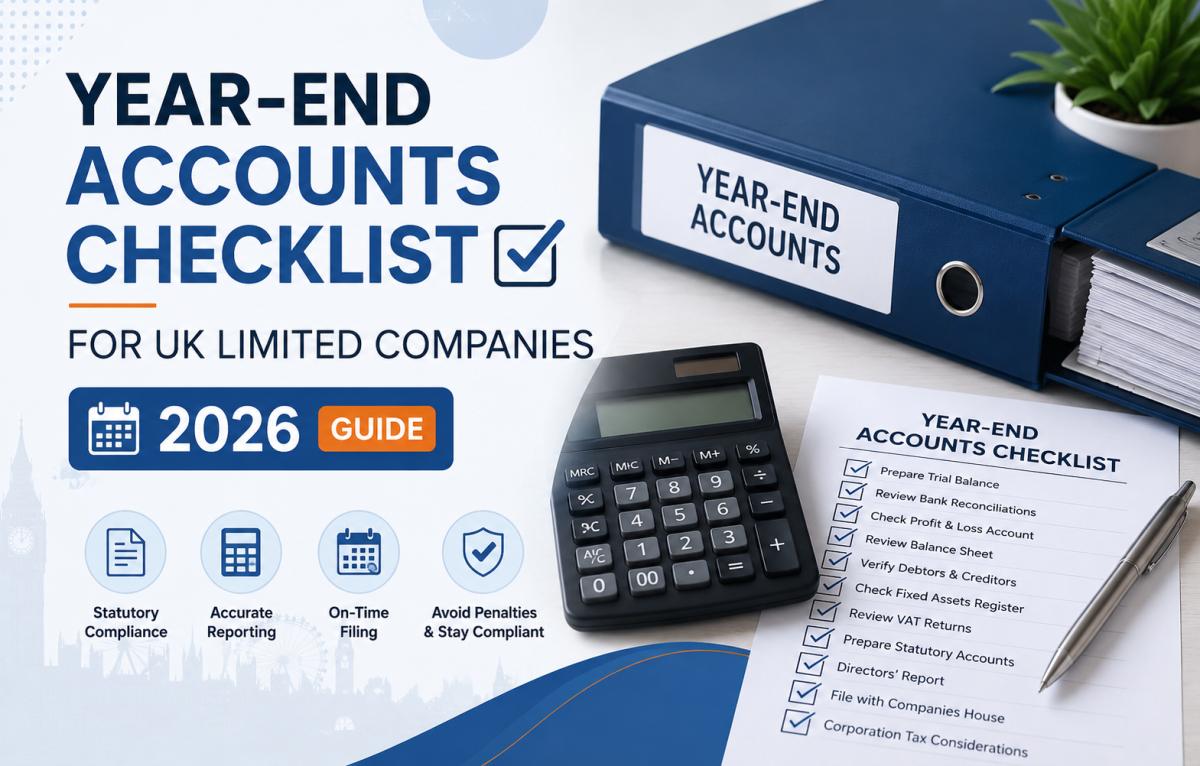
Missing a year-end deadline – or filing accounts with errors – can mean penalties from HMRC and Companies House, or a scramble that eats up weeks of your time. This checklist walks UK limited companies through exactly what needs to be prepared, reviewed, and filed at year-end, so nothing slips through the cracks.
Whether you handle your own bookkeeping, work with an accountant, or use an outsourced accounting team, this guide covers every stage: pre-year-end prep, the documents you need, filing deadlines, and common mistakes that trigger HMRC queries.
What Are Year-End Accounts?
Year-end accounts (also called statutory accounts or annual accounts) are the financial statements every UK limited company must prepare at the end of its financial year. They typically include:
- A profit and loss (income) statement
- A balance sheet
- Notes explaining figures in the accounts
- A director's report (for most companies)
These accounts go to Companies House (for public record) and form the basis of your corporation tax return to HMRC.
Year-End Accounts Checklist: Step by Step
1. Confirm Your Company's Financial Year End
Your financial year end is usually the anniversary of the last day of the month your company was incorporated, unless you've changed it. Check this on Companies House before doing anything else – deadlines are calculated from this date.
2. Reconcile All Bank Accounts
Every business bank account, credit card, and PayPal-type account needs to be reconciled against your accounting software (Xero, QuickBooks, Sage, etc.) up to the year-end date. Any unexplained transactions should be resolved before moving forward.
3. Chase and Record Outstanding Invoices
- List all unpaid customer invoices (accounts receivable).
- List all unpaid supplier bills (accounts payable).
- Write off any genuinely bad debts.
4. Value Your Stock and Work in Progress
If you hold inventory or have ongoing projects, you'll need a stock valuation and work-in-progress figure as of the year-end date. This directly affects your profit figure and tax liability.
5. Review Fixed Assets and Depreciation
Update your fixed asset register — add new purchases (equipment, vehicles, computers), remove disposals, and calculate depreciation for the year using your chosen method (straight-line or reducing balance).
6. Account for Accruals and Prepayments
- Accruals: costs incurred but not yet invoiced (e.g., an unbilled utility charge)
- Prepayments: payments made in advance for the next financial year (e.g., annual software subscriptions)
Check Director's Loan Accounts
If money has moved between the company and a director personally, this needs to be clearly recorded. Overdrawn director's loan accounts can trigger additional tax charges (Section 455), so this is worth reviewing carefully before year-end.
8. Reconcile VAT (If Registered)
Make sure your VAT returns for the year tie back to your accounting records and that any VAT owed or reclaimable is correctly reflected in the accounts.
9. Review Payroll and Pension Figures
Confirm PAYE, National Insurance, and pension auto-enrolment contributions match what's been reported to HMRC through RTI submissions during the year.
10. Prepare the Corporation Tax Computation
Calculate taxable profit (which differs from accounting profit due to disallowable expenses and capital allowances), apply the current corporation tax rate, and identify any reliefs or allowances you're entitled to claim.
11. Draft and Review the Statutory Accounts
Once the above is complete, draft the full accounts — profit and loss, balance sheet, notes, and director's report — and have them reviewed before filing.
12. File With Companies House and HMRC
Submit your statutory accounts to Companies House and your corporation tax return (CT600) with accompanying accounts to HMRC.
Key UK Filing Deadlines to Remember
Filing deadline for Statutory accounts to Companies House 9 months after year-end (first year may differ) Corporation Tax payment to HMRC 9 months and 1 day after year-end; Corporation Tax return (CT600) 12 months after year-end
Always confirm current deadlines and rates on GOV.UK, as they can change from year to year.
Common Mistakes That Trigger HMRC Queries
- Mismatched VAT and accounts figures — inconsistencies between VAT returns and year-end accounts are one of the most common red flags.
- Unreviewed director's loan accounts — overdrawn balances left unaddressed can result in unexpected tax charges.
- Missing or estimated stock valuations – rough guesses instead of a documented valuation process can be challenged.
- Late filing — even a one-day delay can trigger an automatic Companies House penalty.
Should You Handle Year-End Accounts Yourself or Get Help?
For very small, simple companies, DIY year-end accounts are possible with good software and a clear process. But as transaction volume, payroll headcount, or complexity (stocks, multiple directors, or VAT schemes) increases, the risk of errors — and the time cost — grows quickly.
This is exactly where many growing UK businesses turn to outsourced accounting support: a dedicated team handles the reconciliations, valuations, and computations, while you review and sign off, rather than doing the groundwork yourself.
Our outsourced year-end accounts service covers the entire process above — bank reconciliations, stock and asset valuations, accruals and prepayments, director's loan account reviews, and corporation tax computations — prepared by a dedicated team and reviewed against UK compliance standards before anything is filed. It's built for businesses that want the checklist above handled properly, without pulling a director or in-house bookkeeper off other priorities during the busiest filing period of the year.
Conclusion
Year-end accounts don't have to be a last-minute scramble. Working through this checklist systematically — reconciliations, valuations, accruals, director's loans, and tax computations — well before your deadline gives you time to catch errors and avoid HMRC penalties.
If you'd rather hand this process to a team that handles UK year-end accounts and corporation tax filings every day, explore our outsourced year-end accounts service or [INSERT CONTACT PAGE URL HERE] to get a free consultation on how outsourced support can take this off your plate.
Ready to Scale Your Business?
Connect with our experts to learn how our outsourcing solutions can drive growth.
Book a Discovery Call