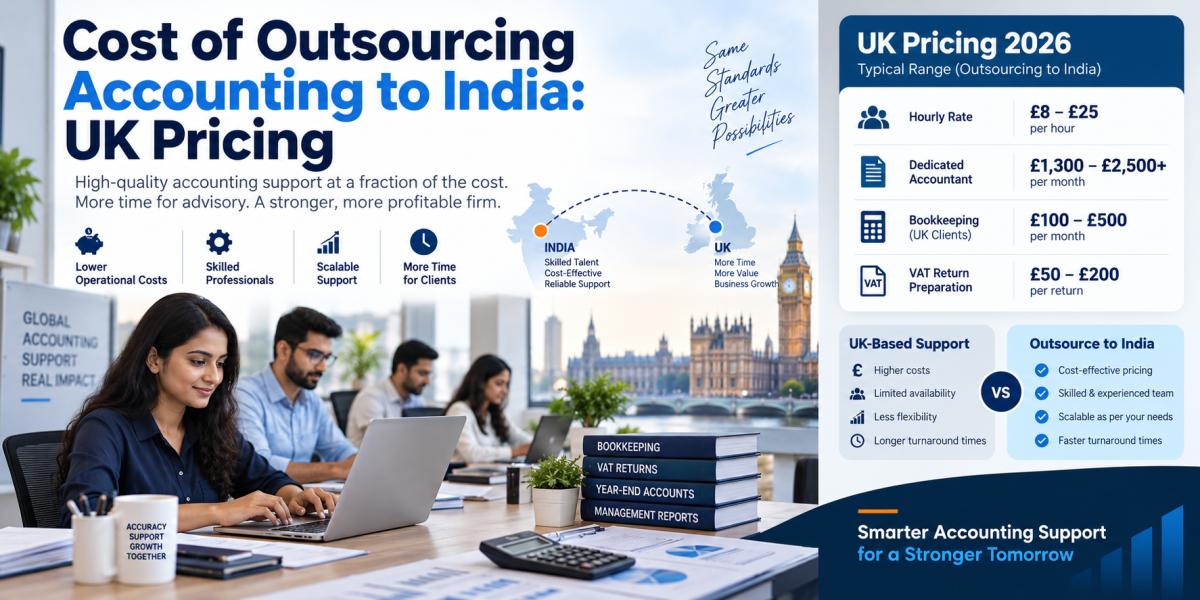
Introduction: The 2026 Shift in UK Accounting Hiring
There really is a truly profound change happening in the UK accounting industry at the moment, and understanding why UK accounting firms are hiring offshore teams instead of recruiting in 2026 has become essential for practice owners. For years, firms have been placing job adverts on Reed and LinkedIn, conducting panel interviews and fighting for the limited number of new local candidates. Many now are simply turning their back on this and setting up offshore accounting teams much more quickly than most outside the industry have understood.
This change has not been solely due to one thing. It is caused by a combination of ever-increasing salary inflation, a declining supply of qualified bookkeepers and accountants, lower margins through the profession, and a realisation that the offering of accounting outsourcing services has advanced to such a degree that even the most risk-averse, compliance-centric firms are becoming aware of it.
For UK accounting firms; ACCA practitioners; and bookkeeping practices, large or small, the question in 2026 isn't 'Shall we be thinking offshore?' 'It's 'How do we do it properly, without causing ourselves new headaches?'. This article looks at why the offshore trend is picking up pace, which work practices are delegating out first, how to cope with quality assurance and compliance issues and what a practical set-up actually looks like. It doesn't matter if you're a sole trader with a bookkeeping practice or a regional accountancy firm employing 30 staff. This issue is relevant to what you do. Read on.
---
Why Offshore Teams Beat Local Recruitment
The economics of UK accounting recruitment has changed beyond recognition. Practitioners that would previously budget 28k-32k for a novice accounts assistant are being quoted salary demands 20-30% above this level, with no assurance that their new recruit will be on site in twelve months' time. Added to this, the ongoing skill shortages are forcing practice owners to reconsider alternative ways of staffing through offshore accounting team solutions.
Rising UK Hiring Costs and Salary Pressure
The pricing for accounting staff in the UK has increased rapidly since 2022 and hasn't dropped again. A qualified bookkeeper in the city is 35,000-42,000. Even away from London, you can expect to pay over 30,000 for mid-level positions regularly.
Factor in employer national insurance contributions, pension auto-enrolment, holiday pay, sick cover, and the cost of recruitment itself – and annually the true cost of one person can be over 45,000. For any small to mid-sized practices where margins are already thin, this just doesn't add up anymore.
Persistent Skills Shortages in Bookkeeping and Accounting
The talent shortfall is here to stay. Both ACCA and ICAEW have raised concerns about the number of newly qualified accountants going into practice. It is becoming increasingly difficult to find bookkeepers—a challenge driven by the way in which cloud software alters the nature of the work as well as the fact that many of today's recruits see a career in broader finance rather than practice-based bookkeeping.
Many firms report leaving a role vacant for three to five months before filling it. This puts significant pressure on delivery.
The Business Case for Accounting Outsourcing Services
Something even more significant is the profile of the costs, which indeed look to be a lot lower. A well-qualified offshore accountant or bookkeeper experienced in Xero, QuickBooks and Sage is about 50-65 per cent cheaper to employ than an equivalent member of staff in the UK. But cost is not why this is happening.
Flexibility is also key. A practice can take on more capacity before the self-assessment deadline in January or the accounts season end in April without actually employing anyone permanently. That real flexibility is valuable to many practices.
---
Offshore Accounting Team vs In-House Recruitment
When comparing offshore staffing to hiring locally, you need to get past the headline pay figure. For most UK companies operational factors – speed, control and long-term flexibility – are equally important.
| Factor | Offshore Accounting Team | In-House Recruitment |
|---|---|---|
| Cost | Lower fixed overheads | Higher salary and employment costs |
| Speed to hire | Faster onboarding | Longer recruitment cycles |
| Scalability | Easier to scale up or down | Slower to adjust capacity |
| Specialist support | Broad access to trained staff | Limited by local talent pool |
Cost, Speed, and Scalability Compared
Offshore onboarding, with an experienced provider, generally takes anywhere between two and four weeks from agreeing the contract to getting the offshore team to work. Compared to a UK recruitment cycle, averaging eight to twelve weeks from job advertising to go-live – and again, that's if the first candidate accepts the offer – you start to realise the magnitude of the time saving for the client. This is particularly true for a company under delivery pressure: during times of undercapacity, scaling down offshore is much less painful than reducing local resources.
Quality Control, Supervision, and Communication
The number one issue the business asks is, 'Is it possible to deliver quality when working from home?'
The truth is yes, but only if you have the right system. The best offshore companies design simple, transparent review process flows; have a specific UK-based reviewer for every output; and communicate effectively through teams like Skype or Slack with a shared monitoring system for deadlines. It isn't that different to managing a remote employee in the UK, but the processes are more consciously thought through.
---
What Work UK Accounting Firms Are Outsourcing First
Most companies begin by outsourcing high-volume, operational rather than in-depth, advisory functions. Which makes sense. Offshore teams deliver most value in their ability to undertake repetitive, rule-based, labour-intensive work that is also time-consuming, thus enabling senior UK staff to focus on client relationships and more value-added decisions.
Bookkeeping and Transaction Processing
Bank reconciliations, sales and purchase ledgers, coding transactions and supplier invoices are the most common work to be outsourced initially. These are standardised and can be easily checked by a UK accountant within a matter of minutes. These operations also tend to take up the most time when processed in the office.
Offshore bookkeeping support has become very popular with practices catering to small business clients on fixed-fee packages, where margin protection is of concern.
VAT, Payroll, and Management Accounts Support
As bookkeeping settles down offshore, many firms will begin to also outsource VAT return preparation, processing of payroll and the production of draft management accounts. These all entail more technical work but can still be quite process-driven given the right templates and review process. Offshore staff who are trained up on the UK VAT regime and the payroll regulations of HMRC will be able to carry out the preparation work, with sign-off still sitting with the UK accountant.
Tax Prep, Year-End, and Overflow Work
Year-end accounts and personal tax return drafting are among the most popular outsourcing jobs, especially in the October-January rush. Practices find that using offshore capacity helps them cope with peak workloads without adding to their permanent headcount. This approach of using a steady backbone of the practice supplemented by ramped-up offshore resources is on the way to becoming a common feature of the best modern practices in the whole of the UK.
---
Compliance, Data Security, and Quality Risks
It's not just about the benefits; you can't have a comprehensive article about offshore accounting without a word on the real risks involved. A "get it right the first time" approach will save both the firm and clients a heap of headache.
GDPR, Client Confidentiality, and Secure Workflows
UK GDPR applies to client data no matter where it is handled. Companies need to check offshore suppliers have suitable data processing contracts in place, use appropriate security controls and limit access on a need-to-know basis. Good offshore partners should already have ISO 27001 accreditation or similar security controls.
Cloud-based bookkeeping platforms (Xero and QuickBooks both enable access by role level) can be used to control what offshore staff have access to.
ACCA Expectations and Supervision Standards
The ACCA practice issues regarding supervision, quality review and technical standards are equally applicable to an offshore practice whether the work is done in the UK or offshore. The firm takes responsibility for the work; every piece of work requires a technically competent UK review before reaching the client; offshore staff are not independent practitioners but are working within the supervised practice model (which does matter professionally and regulatorily).
Lessons from Regulator Scrutiny
Both FRC and ICAEW have indicated more focus on quality management systems within accountancy practices. When firms send offshore work and have no evidence of review procedures, escalation procedures, or training records, they are exposing themselves to audit risk. The firms that succeed in this area view offshore delivery as part of their formal quality management system – rather than taking a less formal approach – and this really helps when under a regulatory review.
---
How to Build a Successful Offshore Accounting Team
Achieving the optimum arrangement for offshore staffing takes more than a mandate to a vendor. The most successful firms spend considerable time ahead of implementation planning out processes, choosing vendors, and integrating the operation with their other business systems.
Choosing the Right Offshore Partner
Due diligence is very important here. Find out if the provider has specific UK accounting firm experience – not just BPO in general. Enquire about what experience the team has, any staff turnover, how the supervision is managed in their operation, what accounting programmes they use, how good their English language skills are and what the culture and communication style of the provider is like.
A culturally good language provider with clear communicative staff will be invaluable and is well worth paying extra for.
Building Processes, KPIs, and Communication Routines
Standardised workflows are key to successful offshore delivery. Document every activity the offshore team will be executing – at least through the process, and with screenshots if appropriate. Agree on transparent turnaround expectations, such as bank reconciliations within 24 hours of statement receipt, a weekly rhythm for updates, and a clear definition of escalation if clarification is needed.
KPIs must include accuracy, turnaround compliance, and volumes – not just work output.
Integration with UK Systems and Bookkeeping Practices
Most UK accounting practices are already in the cloud, which makes offshore integration easier. Offshore teams can work directly in the same Xero or QuickBooks package as the UK team, with the correct level of access and permissions. Document management packages such as Senta, Karbon or even SharePoint can be used to centralise files and track tasks.
Ideally, the location of the person doing the work ceases to be relevant to the end quality and knowability of the work.
| Setup Area | What to Check | Why It Matters |
|---|---|---|
| Software access | Xero, QuickBooks, and document tools | Ensures smooth daily work |
| Review structure | Named reviewer and escalation path | Protects quality and accountability |
| Reporting cadence | Daily, weekly, or monthly updates | Improves visibility for UK firms |
---
Conclusion: Why Offshore Hiring Becomes Default
The move toward an offshore accounting team isn't a mere fad motivated by cost-cutting post-pandemic. It indicates a fundamental shift in the future shape of UK accountancy practices – in a market where local people are too costly, too hard to attract and too mobile, it's no longer feasible to 'build growth' from within. The firms adopting this model aren't 'skimping' – most are well-known ACCA practices with robust client lists and standards to meet. They're just realising that the previous model of recruitment isn't effective anymore.
Is a good offshore arrangement distinguishable from a poor one? More often than not, the defining factor is process discipline. Consistently high-performing firms spend time on defining processes, implement robust review procedures and conduct proper partner due diligence, while poor firms treat offshore staff as a short-term cost-cutting measure with consequent quality issues jeopardising client relationships and compliance.
For UK accountancy practices, bookkeepers and ACCA teams, the practical lesson is quite clear: before you release your first work stream offshore, establish a definitive scope; select a provider that has genuine UK accounting experience; develop your review process ahead of the first task offshore; and approach the long term, whether it is the operational model or not. When properly organised, an offshore accountancy team gives practices the scalability, cost structure and flexibility to expand sustainably, and in the difficult climate of 2026, that will make a real difference. If you have yet to investigate accounting outsourcing services for your practice, then there is little better time to do so.
---
Frequently Asked Questions
Why are UK accounting firms hiring offshore teams in 2026?
The key drivers are cost pressure, skills shortages and scalable capacity. Salaries for accounting and bookkeeping staff in the UK have increased dramatically, making it cost-prohibitive for practices on fixed-fee models to recruit locally. At the same time the available reservoir of qualified candidates locally has diminished.
Offshore accounting teams can provide trained staff, at a lower cost, more rapidly and flexibly than UK-based practice teams, precisely where it will solve actual day-to-day business problems.
Is an offshore accounting team suitable for small bookkeeping practices?
Certainly the smaller practices can also benefit, but the model is a little different. A sole trader bookkeeper or a two-person practice could start engaging one offshore resource to do the transaction processing and reconciliations work, and the owner could free himself up for more client contact / advisory work. The important part here is having a mutually agreed scoping of a task list with someone who is familiar with practices of this size.
There are a number of offshore companies that will now be flexible packages designed for smaller bookkeeping practices in the UK rather than single-source contracts with big firms.
What tasks should not be outsourced offshore?
Client-facing advisory work, particularly involving sensitive financial decisions, or work that involves a judgement that sits within a UK regulatory environment (signing off the accounts, tax advice where there may be a legal implication, correspondence with HMRC that requires knowledge of the client's history, work involving vulnerable clients or confidentiality issues arising from a dispute, etc.) should remain with UK-qualified staff. Offshore teams can be very effective in a support and preparation capacity but the accountability, sign off and relationship should always sit with the UK qualified professional.
Are accounting outsourcing services compliant with UK standards?
They can be, but it will depend on how the relationship is set up. The UK GDPR requires data processing agreements with providers that are located offshore. The ACCA and the ICAEW member firms have to have their controls and reviews in place no matter where the work is produced.
Good accounting outsourcers will have data security certifications, documented procedures and employees trained in UK standards. The accountability stays with the UK practice; therefore, the due diligence in provider choice and internal review processes is essential.
How do offshore teams help ACCA-qualified accountants?
In the hands of the qualified practice accountant, offshore support frees up more time for value-added work by eliminating some of the more mundane processing tasks. Draft preparation, payroll processing, transaction coding, VAT running, and other similar tasks can be undertaken offsite by and for the qualified accountant who will take responsibility for advising the clients, reviewing the work and maintaining the client relationship. This helps make a truly professional working day, which in turn helps with retention and general job satisfaction in this competitive, demanding career.
What is the biggest risk of using offshore staff?
The most common point of failure is weak supervision, as a result of ineffective communication processes. If UK companies don't create transparent review cycles, offshore work will go to clients with no evidence of a thorough review process, leading to quality control issues. Communication breakdowns related to inconsistent briefing, unanswered questions, or misinterpretations of client context create failures that undermine client confidence.
The danger is not offshore work itself but inadequacies in process and leadership: robust review steps, transparent escalation processes and transparent communication routines effectively circumvent these failures in the end.
How do firms measure offshore team performance?
Performance measures are typically established along four dimensions, namely, error levels (percentage of work passing inspection without major rework); turn-around time adherence; work-volume throughput (volume completed in a given period relative to targets); and query resolution turn-around time (time taken by offshore personnel to respond to questions and resolve unclear items). Monthly tracking against the performance measures, along with frequent feedback discussions, helps UK firms get a clear idea whether the offshore set-up is working as planned and where interventions are required.
What should a UK firm ask before hiring offshore accountants?
Enquire with the offshore provider regarding the training and qualifications of their team; their detailed experience with UK accounting conventions and HMRC procedures; the software applications being used regularly by their team; the measures taken to ensure data security and certification levels of their staff; their staff attrition rate (if high, constant ongoing training will be necessary); and what the procedure is for bringing in a new customer. Finally, request references from a UK accountancy practice of similar size and scope of work.
Ready to Scale Your Business?
Connect with our experts to learn how our outsourcing solutions can drive growth.
Book a Discovery Call