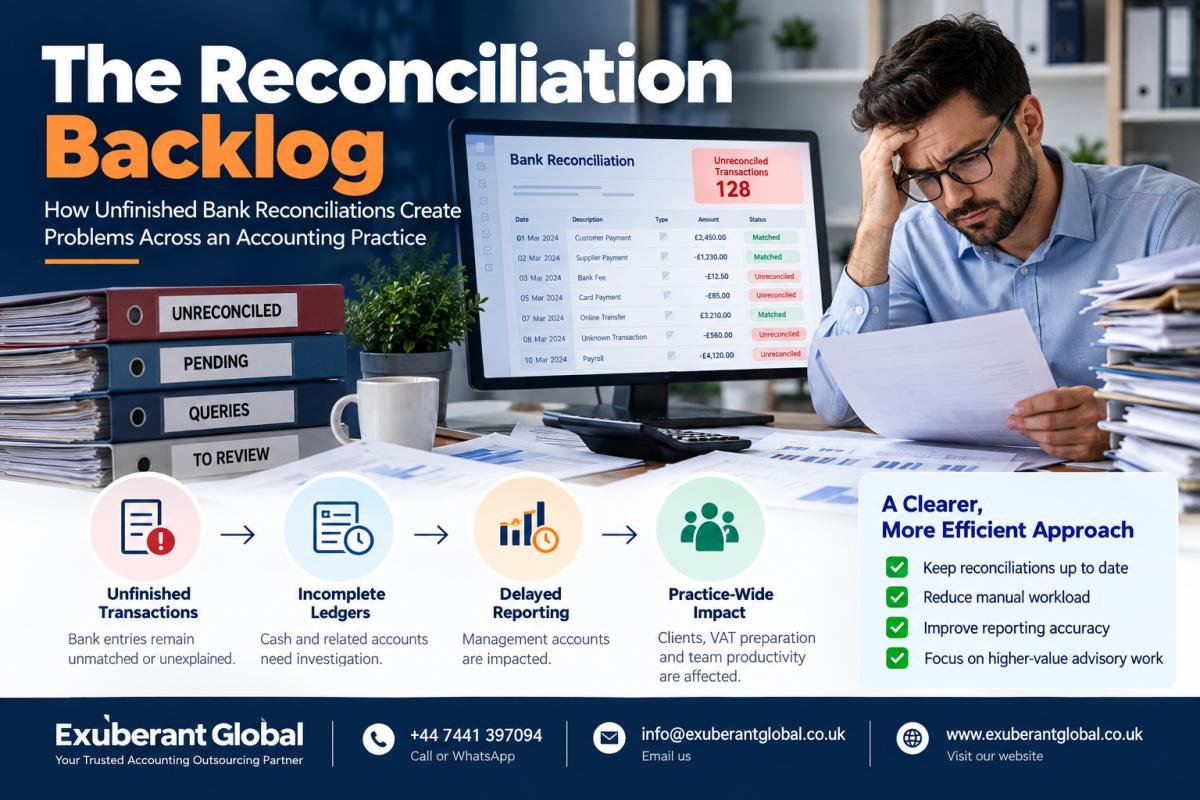
Bank reconciliation is one of those accounting tasks that rarely attracts attention when everything is running smoothly. Transactions are matched, differences are investigated, outstanding items are explained and the books remain up to date.
The problem starts when this routine work begins to fall behind. One month of unfinished bank reconciliations can become two. A few unexplained transactions turn into a long list of queries. Before long, the bookkeeping team is spending more time clearing historical work than maintaining current client records.
For a growing accounting practice, this is more than an administrative inconvenience. A bank reconciliation backlog can affect the reliability of financial information, delay management accounts, complicate VAT preparation and place unnecessary pressure on an already busy team.
Many accounting firms invest in accounting software, automated bank feeds and improved client document collection. Yet these tools cannot completely resolve problems caused by inconsistent transaction processing, missing information, unclear responsibilities or insufficient review capacity.
The important question is not simply how quickly transactions can be imported. It is whether the accounting team can investigate, categorise, match and review those transactions consistently.
This article examines why reconciliation backlogs develop, how they affect different parts of an accounting practice and what firms can do to prevent unfinished bookkeeping from becoming a recurring problem.
1. What Is a Bank Reconciliation Backlog?
A bank reconciliation backlog occurs when financial transactions recorded in a client's accounting system have not been fully compared and reconciled against the corresponding bank or financial institution statements.
In a normal bookkeeping workflow, the accounting team records transactions, matches bank statement entries with ledger entries, investigates differences and ensures that the reconciled balance agrees with the relevant statement balance at the reconciliation date.
When this work is not completed regularly, outstanding transactions and unresolved differences accumulate. The accounting team then has to process both current transactions and previously unfinished work.
A simple example of how a backlog develops
Imagine an accounting practice manages bookkeeping for a client with a business current account and a business credit card. The bookkeeping team is expected to reconcile both accounts every month.
During a busy period, the employee responsible for the client's books is reassigned to urgent year-end work. The latest bank statement is imported, but several transactions remain unmatched. The following month, more transactions arrive before the earlier discrepancies have been investigated.
| Period | Work expected | Work completed | Outstanding position |
|---|---|---|---|
| January | Reconcile January transactions | Partially completed | January work remains |
| February | Reconcile February transactions | Partially completed | January and February work remain |
| March | Reconcile March transactions | New transactions imported only | Three periods require attention |
| April | Complete regular bookkeeping | Historical queries still unresolved | Current and historical work compete for capacity |
The backlog is not simply the number of transactions waiting to be matched. It also includes missing invoices, unidentified receipts, duplicate entries, unexplained bank charges, incorrect postings and outstanding queries that prevent the reconciliation from being completed.
2. Why Bank Reconciliation Is More Important Than Many Firms Realise
Bank reconciliation is a fundamental bookkeeping control. It helps an accounting team establish whether the transactions recorded in the accounting system agree with the activity shown by the financial institution.
This process supports the accuracy and completeness of financial records. It can also help identify missing entries, duplicate transactions, incorrect amounts, unexpected payments and items that require further investigation.
What does a complete reconciliation help verify?
Correct cash balances
Helps establish whether the cash balance recorded in the ledger agrees with the bank statement after accounting for valid reconciling items.
Missing transactions
Helps identify bank transactions that have not yet been entered or correctly recorded in the accounting system.
Duplicate or incorrect entries
Supports the investigation of duplicate postings, incorrect amounts and unexpected differences.
Reliable financial information
Provides a stronger foundation for management reporting, cash flow monitoring and period-end accounting work.
Consider a business that receives customer payments through bank transfers, card processors and online payment platforms. If the bank receipts are not matched against the correct sales invoices and payment records, the accounts team may struggle to establish which invoices have actually been settled.
Similarly, if supplier payments are not correctly allocated, accounts payable records may show balances that do not reflect the actual position.
This is why bank reconciliation should not be treated as a task that can always be postponed until the end of the month or financial year. Its value comes from keeping records accurate and current throughout the accounting period.
3. Why Do Accounting Firms Fall Behind on Bank Reconciliations?
Reconciliation backlogs rarely develop because of one isolated mistake. In many practices, they are the result of several operational issues occurring together.
A team may have enough people to manage normal monthly bookkeeping but insufficient capacity when client numbers increase, employees are absent or additional compliance work arrives.
1. Increasing client portfolios without additional delivery capacity
An accounting firm may take on new clients faster than it can expand its bookkeeping resources. Every new client brings additional bank accounts, payment transactions, credit cards, supplier payments and supporting documentation.
Even when the increase appears manageable individually, the combined transaction volume can place considerable pressure on the bookkeeping team.
2. Missing invoices and supporting documents
Bank statement entries do not always provide enough information to establish the correct accounting treatment. A transaction may need an invoice, receipt, payment reference or client explanation before it can be categorised confidently.
When client documents arrive late or queries remain unanswered, the bookkeeper may have to leave transactions unresolved and return to them later.
3. Staff being diverted to urgent work
Year-end accounts, VAT deadlines, payroll processing and urgent client requests can take priority over routine bookkeeping. If there is no dedicated reconciliation capacity, regular work can be postponed repeatedly.
4. Poor ownership of outstanding transactions
A transaction that nobody owns is unlikely to be resolved quickly. If the bookkeeping team, reviewer and client are unclear about who must investigate an item, it may remain outstanding across several reporting periods.
5. Complex bank and payment arrangements
Some clients use multiple current accounts, savings accounts, business credit cards, payment gateways and foreign currency accounts. Each account creates additional reconciliation work.
Payment processors can make the process more complicated because gross customer receipts, processing fees, refunds and net bank settlements may need to be understood and recorded separately.
6. Insufficient review and quality-control procedures
A bookkeeper may complete transaction matching without properly investigating unusual balances or recurring differences. If reviewers do not have a consistent method for checking completed reconciliations, errors and unresolved items can carry forward.
| Root cause | What happens | Operational consequence |
|---|---|---|
| Limited staff capacity | Regular work is postponed | Growing historical workload |
| Missing client documents | Transactions remain unresolved | Repeated follow-ups |
| Unclear ownership | Queries are not assigned | Longer resolution times |
| Multiple bank accounts | More reconciliation activity | Greater processing demands |
| Weak review procedures | Errors remain undetected | Rework and unreliable records |
4. How a Reconciliation Backlog Affects the Entire Accounting Practice
The most significant problem with unfinished bank reconciliations is that the consequences rarely remain limited to the bookkeeping department.
Accounting workflows are connected. When one stage is incomplete, the next stage may have to wait, work with provisional information or spend additional time checking the underlying records.
Impact on bookkeeping productivity
A team that should be processing current transactions may instead spend a significant part of its working day locating historical entries, checking previous periods and following up on missing documents.
This creates a cycle in which current bookkeeping falls further behind because staff are busy correcting or completing older work.
Impact on management accounts
Management accounts depend on reasonably complete and accurate underlying records. If bank transactions remain unmatched, cash balances and related ledger accounts may require further investigation before the figures can be relied upon.
This can delay the preparation and review of monthly profit and loss accounts, balance sheets and cash flow reports.
Impact on client relationships
Clients expect their accountants to provide timely information and answer financial queries. When reports are repeatedly delayed, the practice may need to explain why the books are not ready or request documents that should have been followed up earlier.
Repeated delays can reduce confidence in the service, even when the underlying cause is a shortage of internal processing capacity rather than a lack of technical expertise.
Impact on staff workload and retention
Employees who regularly inherit incomplete bookkeeping work may experience frustration, particularly when they have to investigate transactions without clear notes or supporting documentation.
The result can be a stressful working environment in which urgent deadlines take priority over consistent processes and long-term improvements.
5. Why Unfinished Bank Reconciliations Delay Management Accounts
Management accounts are only as useful as the information used to prepare them. An incomplete reconciliation can leave questions around the cash position, income received, expenses paid and transactions that require further classification.
For example, a business may have received a customer payment that appears in its bank statement but has not been allocated against the correct sales invoice. Another payment may relate to a loan, director's transaction or transfer between business accounts.
Without proper investigation, these items can affect the completeness and classification of the accounting records.
| Accounting activity | Potential issue when reconciliation is incomplete | Possible result |
|---|---|---|
| Cash reporting | Unexplained differences remain | Cash balances need further investigation |
| Sales ledger | Receipts are not allocated correctly | Customer balances may be misleading |
| Purchase ledger | Payments are not matched to bills | Supplier balances may need correction |
| Expense reporting | Transactions are incorrectly categorised or unclassified | Profit and expense analysis may be incomplete |
| Month-end review | Outstanding items remain unexplained | Additional review and follow-up are required |
This does not mean that every management account must wait for every possible query to be resolved in every circumstance. Professional judgement is essential. However, material and relevant outstanding items must be identified, assessed and appropriately dealt with before financial information is finalised.
Maintaining a consistent bank reconciliation process therefore helps accounting teams prepare more reliable management accounts without repeatedly returning to basic transaction-processing work.
6. The Connection Between Bank Reconciliation Backlogs and VAT Preparation
VAT preparation involves reviewing the accounting records, checking the correct treatment of transactions and ensuring that the relevant figures are supported by appropriate documentation.
An unfinished bank reconciliation can make this process more difficult, particularly when receipts, expenses, refunds or payment processor settlements have not been correctly recorded or explained.
Common problems that arise during VAT preparation
- Unidentified customer receipts: The team may need to establish whether a payment relates to a sales invoice, advance payment or another type of receipt.
- Missing purchase documentation: A payment may appear in the bank account without the supporting supplier invoice or receipt required to assess its VAT treatment.
- Duplicate expense entries: Duplicate postings can distort expense records and potentially affect VAT calculations.
- Payment gateway differences: Fees, refunds and net settlements may require separate accounting entries and supporting records.
- Incorrect transaction coding: Transactions may have been assigned to inappropriate accounts or VAT codes and require review.
HMRC's guidance on digital record keeping under Making Tax Digital for Income Tax explains the importance of accurate digital records and correcting errors. It also makes clear that bank-connected software does not remove the need to check that digital records are accurate.
This is particularly relevant as accounting firms continue to develop their digital bookkeeping workflows and manage clients using connected accounting platforms.
Keeping bank and credit card reconciliations current gives VAT preparers a more organised set of records to review. It also reduces the amount of historical bookkeeping that may need to be completed immediately before a VAT deadline.
7. Seven Warning Signs Your Accounting Practice Has a Reconciliation Problem
A backlog does not always become obvious immediately. In many firms, it develops gradually and becomes visible only when management accounts, VAT work or year-end preparation starts taking longer than expected.
Practice managers can look for the following warning signs.
Repeatedly overdue bank reconciliations
The same client accounts remain unreconciled at the end of successive reporting periods.
Growing lists of unmatched transactions
Uncategorised entries and unexplained differences continue to accumulate.
Frequent last-minute document requests
Staff repeatedly chase missing invoices, receipts and payment explanations.
Month-end reports are consistently delayed
Reviewers cannot complete reporting work because underlying records are incomplete.
The same queries keep returning
Old reconciling items are carried forward without a clear resolution plan.
Staff regularly work overtime
Teams depend on additional hours to clear routine bookkeeping tasks.
Historical bookkeeping becomes routine
Staff frequently spend time catching up previous months rather than maintaining current records.
One warning sign does not necessarily indicate a serious problem. However, several recurring signs together may suggest that the practice needs to review its bookkeeping capacity, workflow ownership and quality-control procedures.
8. Why Accounting Software Alone Cannot Eliminate Reconciliation Backlogs
Cloud accounting platforms have made transaction processing considerably more convenient. Bank feeds, automated matching rules, invoice capture and reconciliation suggestions can reduce repetitive work and improve visibility.
However, software automation does not guarantee that every transaction has been correctly understood or reconciled.
Where automation helps
- Importing bank transactions into accounting software.
- Suggesting matches for recurring payments and receipts.
- Identifying potential duplicate entries.
- Reducing repetitive manual data entry.
- Providing visibility over unmatched transactions.
- Maintaining a more consistent digital audit trail.
Where human review remains important
- Investigating unusual or unexplained transactions.
- Determining the correct treatment of complex entries.
- Reviewing payment processor fees and settlement differences.
- Identifying transactions requiring additional documentation.
- Checking recurring discrepancies and correcting their underlying causes.
- Approving completed reconciliations in line with the firm's review procedures.
| Accounting software can assist with | Accounting professionals still need to do |
|---|---|
| Importing bank feeds | Check whether all relevant transactions are present |
| Suggesting transaction matches | Verify the accuracy of suggested matches |
| Applying recurring rules | Review whether the rules remain appropriate |
| Highlighting differences | Investigate and resolve the underlying reasons |
| Generating reconciliation reports | Review, document and approve the results |
The most effective approach is to combine suitable accounting technology with trained bookkeeping professionals and a documented reconciliation procedure.
9. How to Clear an Existing Bank Reconciliation Backlog
When several clients have outstanding bank reconciliations, trying to complete everything at once can make the situation more difficult. A structured recovery plan helps the practice understand the size of the problem, allocate resources and prevent important deadlines from being overlooked.
Step 1: Identify all outstanding accounts and periods
Start by creating a complete list of clients with overdue bank, credit card and other relevant financial account reconciliations.
Record the latest completed reconciliation date, the number of outstanding periods, approximate transaction volume and any known unresolved queries.
Step 2: Prioritise work based on urgency and risk
Not every account needs to be completed in the same order. Prioritise clients with upcoming VAT deadlines, year-end requirements, material unexplained differences or significant reporting dependencies.
Also consider how long the account has been outstanding and whether the supporting documents are available.
Step 3: Separate straightforward transactions from exceptions
Transactions that can be confidently matched should be processed using the firm's approved procedures. Unusual payments, missing documentation and unexplained differences should be moved into a clearly tracked query list.
This prevents straightforward work from being held up by a small number of difficult transactions.
Step 4: Create an outstanding query register
Every unresolved transaction should have an owner, a description of the issue, the supporting information required and a follow-up date.
| Client | Outstanding item | Action required | Responsible person | Status |
|---|---|---|---|---|
| Client A | Unidentified receipt | Confirm customer payment | Bookkeeper | Awaiting client |
| Client B | Missing supplier invoice | Request supporting document | Client manager | Open |
| Client C | Payment processor difference | Review fees and settlement | Senior bookkeeper | Under review |
Step 5: Allocate dedicated reconciliation capacity
Do not rely entirely on spare time between other tasks. Allocate defined working capacity to historical reconciliation work and ensure that current bookkeeping continues to be maintained.
Where internal capacity is insufficient, consider temporary support or an outsourced bookkeeping team to assist with the processing workload.
Step 6: Review completed work before closing the backlog
A completed reconciliation should be checked against the firm's documented procedures. Unexplained differences should not simply be written off or carried forward without investigation and appropriate authorisation.
Step 7: Monitor progress until the backlog is under control
Track outstanding accounts, completed periods, unresolved exceptions and the age of open queries. Review progress regularly rather than waiting until the next month-end.
10. How Accounting Firms Can Prevent Future Reconciliation Backlogs
Clearing a historical backlog is only part of the solution. If the original causes remain unchanged, the same problem can return within a few reporting periods.
Accounting practices should establish repeatable bookkeeping procedures that make reconciliation a regular activity rather than a task completed only when a deadline approaches.
Establish a consistent reconciliation schedule
Agree on an appropriate frequency for each client's bank and credit card reconciliations. The schedule should reflect transaction volumes, reporting requirements, risk and the nature of the business.
Set clear responsibilities
Assign responsibility for transaction processing, query management, client follow-ups and final review. Employees should understand which work they own and when issues must be escalated.
Use a centralised task and query tracker
A shared tracking system can help practice managers see which clients are up to date, which accounts require attention and which queries are waiting for client responses.
Standardise bookkeeping procedures
Create documented instructions for importing bank feeds, matching transactions, processing transfers, reviewing exceptions and escalating unresolved items. Consistent procedures make it easier to distribute work across a larger team.
Monitor performance using practical KPIs
A few useful measures can help managers identify bottlenecks before they become serious problems.
| KPI | What it measures | Why it matters |
|---|---|---|
| Reconciliation completion rate | Proportion of scheduled reconciliations completed | Shows whether routine work is being maintained |
| Outstanding reconciliation age | How long accounts remain unreconciled | Highlights developing backlogs |
| Unresolved query count | Number of open reconciliation queries | Shows where follow-up is required |
| Query resolution time | Time taken to resolve outstanding items | Identifies delays in communication or processing |
| Rework rate | Amount of completed work requiring correction | Helps identify training and quality issues |
Firms should set realistic targets for these measures based on their client mix, transaction volumes and service agreements. The objective is not simply to complete more transactions but to maintain accurate, reviewed and timely accounting records.
11. When Outsourcing Bank Reconciliation Can Help an Accounting Firm
Sometimes the problem is not the absence of a good bookkeeping process. The real challenge is that the existing team does not have enough capacity to complete all the work within the required timeframe.
Recruiting additional employees can be one solution, but it may not always be the most practical option, particularly when the workload is seasonal, project-based or temporarily increased by new client acquisitions.
In these circumstances, outsourced bank reconciliation services can provide accounting firms with additional processing capacity without requiring them to build every role internally.
What can an outsourced reconciliation team support?
- Bank statement and bank feed transaction processing.
- Business bank account reconciliation.
- Credit card reconciliation.
- Matching receipts and payments against accounting records.
- Reviewing unmatched and uncategorised transactions.
- Identifying missing documents and preparing query lists.
- Payment gateway and settlement reconciliation.
- Historical bookkeeping and reconciliation catch-up projects.
- Preparation of reconciliation reports for internal review.
In-house bookkeeping capacity versus outsourced support
| Consideration | Entirely in-house approach | In-house team with outsourced support |
|---|---|---|
| Work allocation | Managed through internal resources | Routine work can be distributed across teams |
| Capacity during busy periods | May require overtime or additional recruitment | Additional agreed delivery capacity can be introduced |
| Historical backlogs | Compete with current client work | Can be assigned as a separate catch-up project |
| Workflow management | Managed internally | Shared responsibilities and agreed handovers |
| Final professional review | Completed under internal review arrangements | Can remain with the UK firm's designated reviewer |
The most effective outsourcing arrangements are not based on simply transferring a list of transactions to another team. They involve agreed instructions, secure access, documented workflows, clear escalation procedures and consistent quality checks.
Why the right outsourcing partner matters
Before choosing an outsourced bookkeeping provider, accounting firms should consider:
- Experience with UK bookkeeping and accounting workflows.
- Familiarity with platforms such as Xero, QuickBooks and Sage.
- Documented transaction-processing and reconciliation procedures.
- Data protection, confidentiality and access-control arrangements.
- Clear communication and escalation routes.
- Defined responsibilities for processing, checking and approval.
- Flexibility to support recurring work and historical backlogs.
For a more detailed explanation of how outsourcing can work in practice, read our guide to bookkeeping outsourcing to India for UK accounting firms.
You can also explore our outsourced accounting services for UK firms to understand how additional bookkeeping and accounting capacity can fit into an existing practice.
12. Bank Reconciliation Checklist for UK Accounting Practices
A practical checklist can help practice managers ensure that bank reconciliation work is completed consistently and that outstanding items do not disappear between reporting periods.
Before processing
- Confirm the correct bank account and reconciliation period.
- Obtain the relevant bank statement or verify the bank feed.
- Check that the opening balance agrees with the previous completed period.
- Confirm that all relevant accounting records are available.
During reconciliation
- Match bank statement entries with corresponding ledger transactions.
- Check amounts, dates and transaction references.
- Investigate duplicate or missing entries.
- Identify unidentified receipts and payments.
- Review bank charges, interest and transfers.
- Record unresolved items in a query register.
After reconciliation
- Confirm that the reconciliation difference is explained.
- Ensure outstanding items have been appropriately documented.
- Escalate unusual or material discrepancies.
- Complete the required reviewer checks.
- Update the reconciliation tracker.
- Ensure the next reporting period is scheduled.
The exact checklist should be adapted to the client's accounting arrangements and the firm's documented policies. Different clients may require additional checks, particularly where payment processors, foreign currency accounts or multiple bank accounts are involved.
Conclusion: A Healthy Accounting Practice Starts With Up-to-Date Books
Bank reconciliation may appear to be a routine bookkeeping activity, but its impact extends across almost every stage of an accounting practice's delivery process.
When reconciliations fall behind, the consequences can include incomplete ledgers, delayed management accounts, additional VAT preparation work, repeated client queries and unnecessary pressure on bookkeeping teams.
The solution is not simply to work faster when deadlines approach. Accounting firms need consistent reconciliation schedules, clear ownership of outstanding transactions, documented processes and sufficient capacity to maintain current client records.
Where internal resources are stretched, outsourced bookkeeping support can help practices manage recurring reconciliation work, clear historical backlogs and maintain a more consistent workflow.
Ultimately, the objective is straightforward: keep the books current, investigate differences promptly and ensure that every completed reconciliation is properly reviewed.
Falling Behind on Bank Reconciliations? Let's Help You Catch Up.
Your internal team should not have to choose between maintaining current bookkeeping and clearing historical backlogs. Exuberant Global provides outsourced bookkeeping and accounting support for UK accounting firms, including bank reconciliations, transaction processing and historical bookkeeping assistance.
Whether you need support with recurring monthly reconciliations or additional capacity to clear outstanding work, we can discuss a delivery arrangement around your firm's requirements.
Explore Our Outsourced Accounting Services →Frequently Asked Questions About Bank Reconciliation
What is a bank reconciliation backlog?
A bank reconciliation backlog refers to bank or financial account transactions and reconciliation periods that have not been fully processed, matched, investigated or reviewed. It can include unmatched transactions, missing supporting documents and unresolved differences carried forward from previous periods.
Why are bank reconciliations important for accounting firms?
Bank reconciliations help accounting firms verify cash balances, identify missing or duplicate transactions, investigate discrepancies and maintain reliable bookkeeping records. They also support the preparation and review of management accounts and other financial reports.
How often should a business bank account be reconciled?
The appropriate frequency depends on transaction volume, business activity, reporting requirements and the firm's risk assessment. Many accounting workflows use weekly or monthly reconciliation schedules, while higher-volume or more sensitive accounts may require more frequent attention.
What causes bank reconciliation delays?
Common causes include limited bookkeeping capacity, missing invoices, delayed client responses, multiple bank accounts, complex payment processor settlements, unclear responsibilities and insufficient review procedures.
Can bank reconciliation backlogs affect VAT preparation?
Yes. Unmatched receipts, missing purchase invoices, incorrect transaction coding and unexplained payment differences can make VAT preparation more difficult. A complete reconciliation supports the underlying bookkeeping records, although separate checks of VAT treatment and supporting evidence remain necessary.
Can bank reconciliations be outsourced by UK accounting firms?
Yes. UK accounting firms can outsource agreed bookkeeping activities, including bank and credit card reconciliations, transaction processing, query preparation and historical bookkeeping. The outsourcing arrangement should define responsibilities, security requirements, review procedures and communication processes.
Which accounting software can support outsourced bank reconciliation?
Common cloud accounting platforms used in UK bookkeeping workflows include Xero, QuickBooks Online and Sage. The appropriate platform depends on the client's existing systems and the outsourcing provider's capabilities.
How can an accounting practice reduce its existing reconciliation backlog?
Start by identifying overdue accounts, prioritising work according to deadlines and risk, separating straightforward transactions from exceptions, creating an outstanding query register and allocating dedicated processing capacity. Completed reconciliations should be reviewed before being closed.
What should an accounting firm look for in an outsourced bookkeeping partner?
Look for relevant UK accounting workflow experience, software familiarity, documented quality-control procedures, secure information handling, clear communication, defined responsibilities and the flexibility to manage both recurring bookkeeping and historical catch-up projects.
Further Reading and References
The following resources provide additional information about digital record keeping and reconciliation practices:
Ready to Scale Your Business?
Connect with our experts to learn how our outsourcing solutions can drive growth.
Book a Discovery Call