Combining AI Tools and Offshore Teams to Solve the UK Accountancy Talent Shortage
UK practices have a staffing problem that can't be ignored any longer. New student registrations with the ICAEW and ACCA have fallen sharply over the past decade, an estimated 9,000 fewer students enrolled between 2017 and 2022 alone, while ICAEW research shows around two-thirds of accountants aged 55 and over are planning to retire soon. Add in a workforce still adjusting to the post-Brexit drop in EU migration, and firms outside London, particularly in cities like Manchester and Nottingham, are left with just a handful of applicants for every open role.
For firms and finance teams racing to close the books, hit HMRC deadlines under Making Tax Digital, and keep clients happy without burning out the staff they have left, pairing AI tools with offshore accounting teams to solve the talent shortage has moved from a cautious experiment to a proven, cost-effective strategy.
In this article, we break down how this hybrid model works in practice, where it delivers the most value for UK practices, and how to roll it out without sacrificing quality, security, or compliance.
Solving the Talent Shortage Through Strategic Capacity Management
Put simply, the gap isn't just a skills shortage. It's a delivery problem. Firms have the same volume of work, and often more, with fewer hands to do it. Recent sector analysis found that nearly three-quarters of UK practices have had to turn away new client work simply because they don't have the capacity to take it on.
This is showing up as bottlenecks in monthly close cycles, self-assessment season, VAT filing under Making Tax Digital, and slower client reporting. What firms need isn't another job posting. It's a model that expands delivery capacity without depending entirely on a shrinking local hiring pool.
Why Traditional Hiring No Longer Scales
The old playbook of posting a job, finding a qualified accountant, and training them for months doesn't move fast enough anymore. Salaries for ACCA and ICAEW-qualified staff have climbed sharply as larger firms and private-equity-backed consolidators compete for the same shrinking pool, pricing smaller and regional practices out entirely. Time-to-hire is a problem on top of that.
There's also a hidden bottleneck in the pipeline itself: an estimated 180,000 ACCA and ICAEW students are currently stuck mid-qualification, trained enough for junior work but not yet fully chartered. Meanwhile, the team members already on staff are absorbing the extra workload and burning out, with recent surveys finding that a majority of accountants are considering a move in search of better work-life balance. The traditional model is failing on both ends: too slow to fill seats, and too costly to retain the people already in them.
What Makes the Combined Model Different
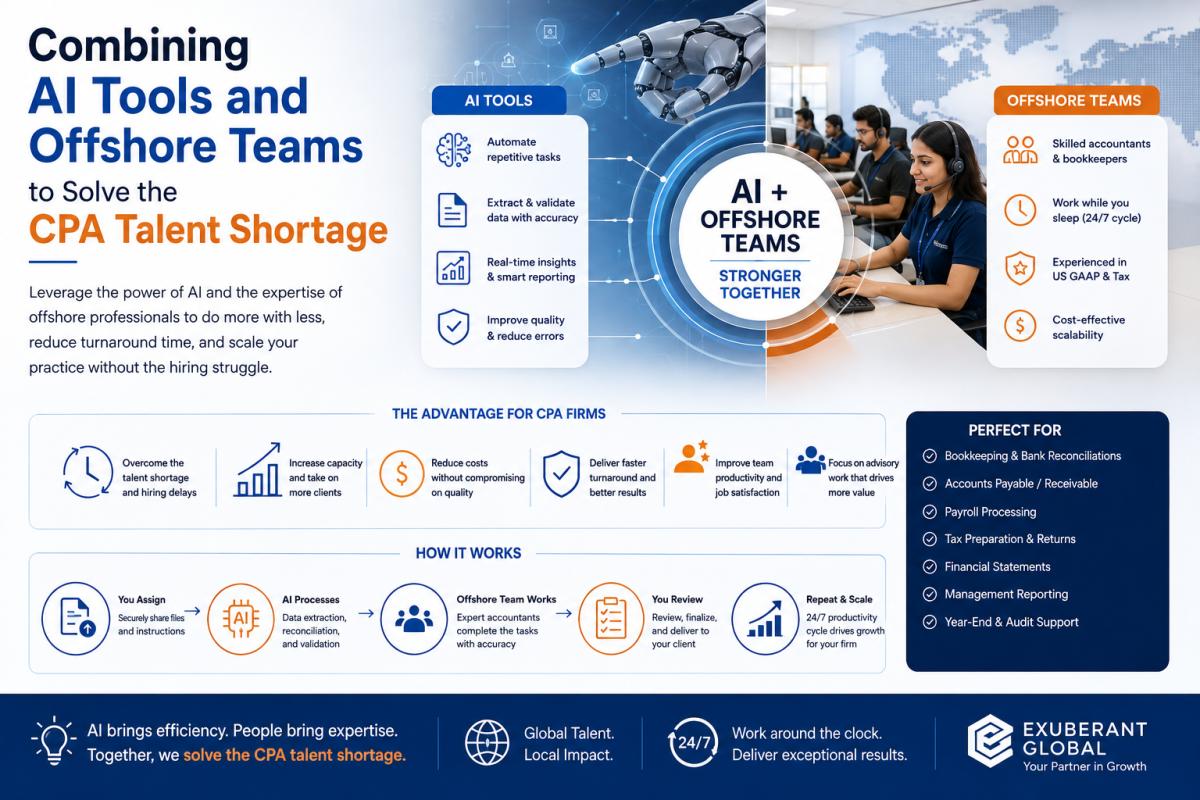
Instead of trying to hire your way out of a labour crunch, the combined model puts work where it belongs based on what the task actually requires. AI handles high-volume, rules-based processing, the repetitive work that doesn't need judgement but does need speed and precision. Offshore accounting professionals, many of them ACCA-qualified or working towards it, handle preparation, review, and coordination work that needs a trained human brain but not one sitting in the same time zone as the client.
That frees up your ACCA or ICAEW-qualified staff to focus on advisory work, client relationships, and the complex judgement calls that actually require their qualification.
AI Tools and Offshore Teams: A Three-Tier Model
The real differentiator between firms that see genuine efficiency gains and firms that just create new coordination headaches comes down to one thing: getting the division of labour right across three tiers, automated, offshore-supported, and qualified UK sign-off.
| Tier | Best suited for | Example tasks | Turnaround |
|---|---|---|---|
| AI automation | High-volume, rules-based, repetitive work | Invoice capture, bank reconciliations, OCR data extraction | Minutes to hours |
| Offshore team | Judgement-based work that doesn't require proximity | Bookkeeping, draft financials, exception review | Same day to 24 hours |
| UK-qualified sign-off | Advisory, sign-off, and complex judgement calls | Client strategy, final review, tax planning | Scheduled, high-value time |
Best Use Cases for AI in Accounting Workflows
Automation delivers the most value in high-frequency, rule-based processes. The strongest use cases include:
- Accounts payable processing: invoice capture, three-way matching, and payment scheduling
- Accounts receivable: automated reminders, cash application, and aging report generation
- Bank and credit card reconciliations: matching transactions against the general ledger at scale
- Document extraction: pulling structured data from PDFs, receipts, and statements using optical character recognition
- Making Tax Digital compliance: keeping digital records and VAT submissions on schedule
- Routine financial reporting: generating standard variance reports and dashboards on a set schedule
None of this is glamorous work, but it adds up to a lot of hours. Automating it frees up staff, both offshore and UK-based, to spend their time on work that actually requires a brain.
Best Use Cases for Offshore Teams
Offshore accountants, typically based in established outsourcing hubs like India or the Philippines with deep ACCA-aligned talent pools, are most effective on work that requires judgement but not physical proximity. Their responsibilities typically include:
- Bookkeeping and transaction coding across multiple client accounts
- Preparing draft financial statements for UK-qualified review
- Supporting month-end close checklists and follow-ups
- Communicating with clients or vendors on routine documentation requests
- Reviewing AI-processed outputs for exceptions and flagging anomalies
The offshore layer acts as a safety net between automation and final sign-off, catching errors before they cost time and keeping processes moving overnight while the UK team is offline.
How the Work Flows: Every Path a Transaction Can Take
Not every transaction takes the same route. Clean, straightforward data moves fast. Anything unusual gets extra eyes on it before it reaches the client. The infographic below maps the complete picture, start to finish, including what happens when something needs to be sent back:
How the Work Flows
Every path a transaction can take, from intake to client delivery
|
Transaction received
Invoices, receipts, bills
|
| ↓ |
|
AI intake & processing
Capture, code, and match
|
| ↓ |
|
CLEAN DATA ↓
Auto-posted to ledger
Clean, rule-based data
|
EXCEPTION FOUND ↓
Flagged for offshore
Exceptions, anomalies
|
| ↓ |
|
Offshore review
Resolves or escalates, compiles close packet
|
| ↓ |
|
UK-qualified review
Final check and sign-off
|
|
REVISION NEEDED ↓
↻ Sent back to offshore
Loops back for correction
|
APPROVED ↓
Delivered to client
Reporting and advisory
|
The loop back to offshore isn't a failure state; it's a normal part of quality control. It's what keeps errors from reaching the client in the first place.
Building the Right Workflow and Governance
Running AI tools and offshore teams without structure usually produces inconsistent results. Firms that win with this model spend time upfront designing the process, not just picking the technology.
Standardise Before You Automate
Automation accelerates whatever you already do. If your workflows aren't standardised or your data is messy, AI tools will scale up your errors just as fast as they scale your output. Make sure the basics are covered before layering on automation:
- Document your existing processes in clear SOPs (standard operating procedures)
- Clean up your chart of accounts, vendor master data, and client records
- Establish consistent naming conventions and file structures
- Identify which processes are stable enough to automate versus which still need redesign
Skipping this step is one of the most common reasons automation projects underperform. The technology works fine. It's the inputs that don't.
Define Roles, KPIs, and Escalation Paths
Without clear ownership, work falls through the cracks between process layers. Every step needs an owner, an expected turnaround time, and a documented escalation path for exceptions. In practice, that means:
- Assigning specific task categories to AI, offshore staff, or UK-qualified sign-off, not leaving it ambiguous
- Setting measurable KPIs such as reconciliation completion rate, days to close, and error rate per batch
- Establishing handoff rules so offshore teams know exactly when to escalate versus resolve independently
- Scheduling regular quality review meetings between UK leads and offshore managers
Common Questions About the Hybrid Model
Is offshore accounting support secure and GDPR compliant?
Reputable offshore providers work under the same data security and confidentiality standards UK firms expect domestic compliance, including encrypted data handling, access controls, and signed confidentiality agreements, alongside appropriate data transfer safeguards under UK GDPR. Firms should vet a provider's security certifications and compliance track record before onboarding, the same way they'd vet any vendor handling sensitive financial data.
Will clients notice a difference in service quality?
When the model is set up correctly, clients typically notice faster turnaround and more consistent reporting, not a drop in quality. Your ICAEW or ACCA-qualified staff remain the point of contact for strategy and sign-off, while the offshore and automated layers work behind the scenes to keep deadlines on track.
How long does it take to implement this model?
Most firms can pilot a hybrid workflow within a single quarter, starting with one process, such as accounts payable or reconciliations, before expanding to close cycles and Making Tax Digital reporting. The upfront work of standardising processes tends to take longer than the technology rollout itself.
Conclusion: A Scalable Model for Modern UK Practices
The UK accountancy talent gap isn't going to fix itself, and waiting for the hiring market to rebound isn't a strategy. Pairing AI automation with skilled offshore accounting support gives firms a practical path to delivering the quality and timeliness clients expect, without burning out the local team.
Firms seeing the best results tend to share a few habits:
- They standardise processes before adding technology or offshore capacity
- They treat offshore professionals as genuine team members, not just task processors
- They reserve ICAEW- and ACCA-qualified staff for high-value advisory work rather than routine processing
- They build governance, KPIs, escalation paths, review cadences, from day one
This isn't a shortcut. It takes real investment in designing workflows, clarifying communication, and defining roles up front. Done well, though, it leads to a more flexible, scalable operation that can grow without the constant headache of local hiring, particularly for practices outside London struggling with the smallest talent pools.
For firms serious about staying competitive in a tight talent market, this model isn't worth a cautious pilot anymore. It's worth building today.
Ready to Scale Your Business?
Connect with our experts to learn how our outsourcing solutions can drive growth.
Book a Discovery Call